
This article was published in Scientific American’s former blog network and reflects the views of the author, not necessarily those of Scientific American
What’s surprising about the Zika virus circulating in Singapore right now is that it appears to be so familiar. New genome sequencing analysis suggests that the virus that has sickened hundreds of people in the Southeast Asian city–state most closely resembles the same Zika strains that have circulated in the region for more than 50 years, rather than those currently fueling birth defects in Latin America and elsewhere.
Both strains originated in Asia, according to the World Health Organization, but the strains that have circulated there since the 1960s did not cause massive, detectable outbreaks or birth defects. So what has changed? We don’t know. What we do know is that the virus now spreading in Singapore—a small, prosperous island with nearly six million people—has caused more than 200 confirmed Zika cases in recent weeks. Now researchers must try to unravel why.
Singapore’s Ministry of Health said today that analysis by local scientists shows that at least two sequenced virus samples in the area indicate that the form of Zika spreading there is more similar to the virus that has circulated in Southeast Asia since the 1960s—that is, before the disease spread to French Polynesia in 2013 and subsequently to Brazil, causing huge outbreaks and complications including Guillain–Barre syndrome and birth defects. “Currently there is no evidence from existing studies and from this sequence to indicate whether the differences between these strains and the South American virus correlate with differences in severity or type of disease,” the Ministry of Health said. The severity question is exactly what researchers are now wondering about amid this latest finding. (Until the first large outbreak of Zika in 2007 in Micronesia, the virus in Southeast Asia caused very few noticeable cases of disease and did not cause birth defects, or at least was not known to do so.)
On supporting science journalism
If you're enjoying this article, consider supporting our award-winning journalism by subscribing. By purchasing a subscription you are helping to ensure the future of impactful stories about the discoveries and ideas shaping our world today.
Naturally, this genome finding may be viewed as somewhat good news. But public health responders and researchers must remain cautious and tamp down their optimism as they try to control the current outbreak. As WHO said in an e-mailed statement, “The absence of proof of neurologic complications should not be assumed to indicate proof of absence; there have not been sufficient numbers of investigated Zika cases in either Southeast Asia or Africa to definitively rule out the possibility of microcephaly or other congenital malformations, or [Guillain–Barre syndrome], in these settings.”
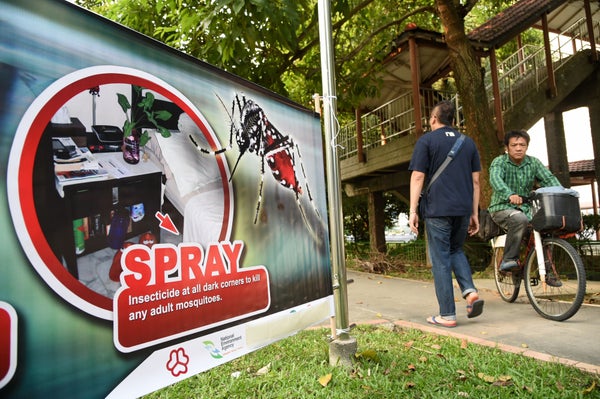
Singapore’s government has a long history of using aggressive spraying, information campaigns and heavy fines for homeowners who leave water vessels in the open, in a bid to control mosquito-borne dengue. But Zika can also hop from person to person via sexual transmission, complicating Singapore’s efforts against the latest outbreak. The other issue is that Singapore is such a bustling trade and transport center connecting places like China, India, Africa and the West, which raises questions about containing Zika. As of September 4 there were already 242 confirmed Zika cases in the country.
The cluster of cases in Singapore underscores how important it is to continue studying different aspects of this pernicious virus. Those include whether specific mutations may have changed how it affects its human victims, and whether other risk factors—say infection with other diseases or other exposures—might somehow influence Zika’s severity.