Jellyfish in Motion

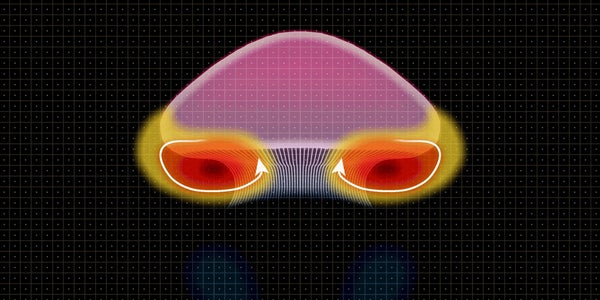
Animation shows how a moon jelly propels itself using spinning wheels of water

Join Our Community of Science Lovers!

This article was published in Scientific American’s former blog network and reflects the views of the author, not necessarily those of Scientific American

Animation by Eleanor Lutz

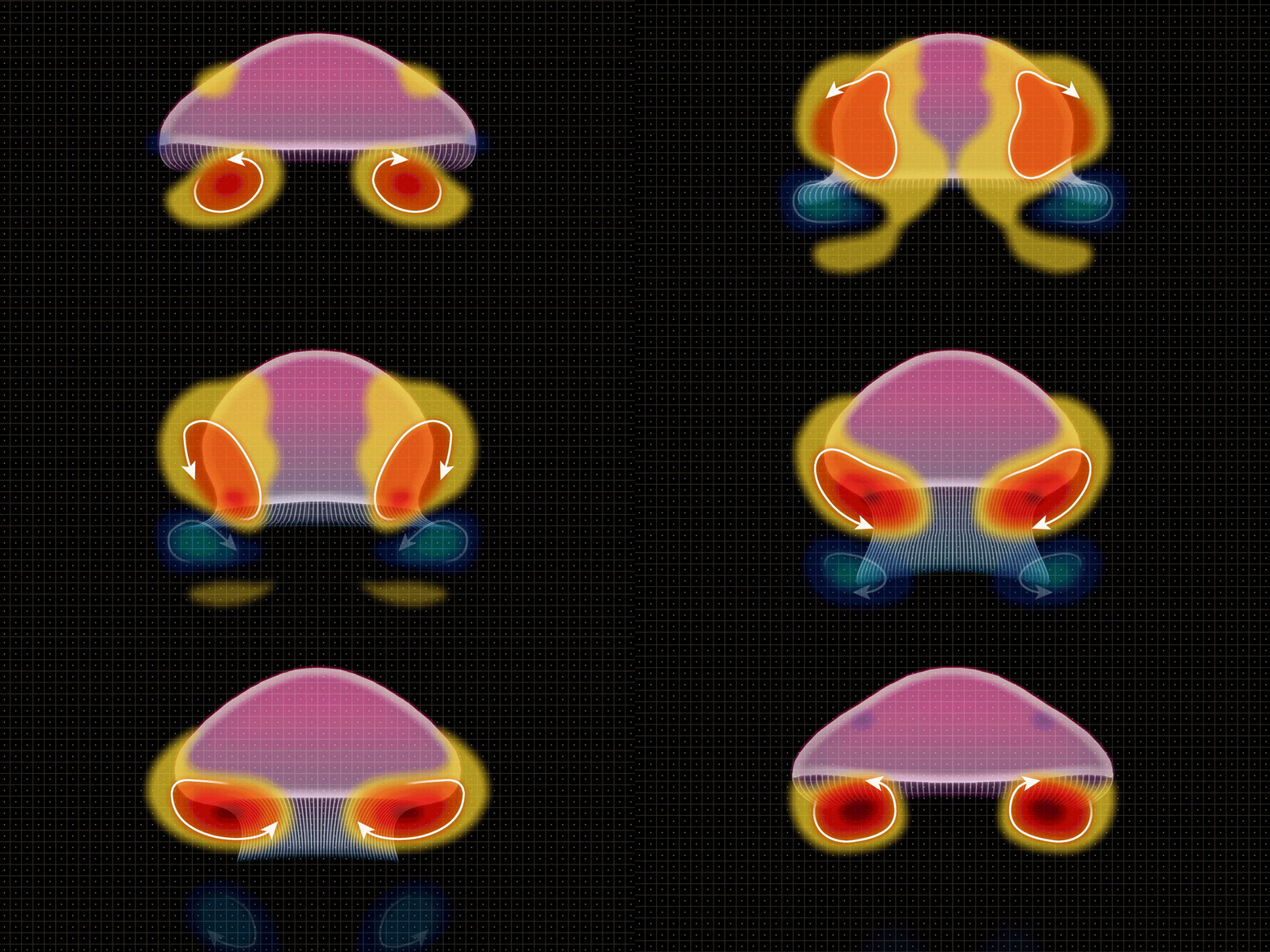
For an article in the May issue of Scientific American, Eleanor Lutz—with input from Bradford J. Gemmell, a marine biologist at the University of South Florida—developed a series of illustrations that demonstrate how jellyfish manipulate water pressure to alternately pull and push themselves through water. 

If you're familiar with Lutz's captivating animated GIFS, you'll see why I couldn't resist asking her to create an animated jellyfish as well. In the static print version, the focus is on water pressure. In this motion version, Lutz represents water flow direction and speed. As the jellyfish flexes and contracts its muscles, a donut of spinning water—called a vortex—rolls downwards then up under the bell edge. This view shows a cross section of that vortex ring as it rolls down over a stylized Aurelia aurita moon jelly (pink). The red zones represent the fast spinning core of the slower-spinning primary vortex (yellow). A secondary, weaker vortex (blue) spins off in the opposite direction. Above the bell, the yellow vortex contributes to a relatively weak pressure zone, pulling the critter forward. Once under the bell, the residual faster-moving core acts like a paddle wheel, pushing a water jet in between them and up underneath the jelly, providing an extra boost.


On supporting science journalism

If you're enjoying this article, consider supporting our award-winning journalism by subscribing. By purchasing a subscription you are helping to ensure the future of impactful stories about the discoveries and ideas shaping our world today.


For technical details on jellyfish biomechanics, see "Exploring vortex enhancement and manipulation mechanisms in jellyfish that contributes to energetically efficient propulsion" by B. J. Gemmell, J. H. Costello and S. P. Colin, and "Suction-based propulsion as a basis for efficient animal swimming," by B.J. Gemmell, S. P. Colin, J. H. Costello and J. O. Dabiri.

Interested in more jellyfish imagery? Check out the mesmerizing video in Jennifer Frazer's post on a recently discovered deep sea jelly, throught to belong to the genus Crossota.

Jen Christiansen is acting chief of design and senior graphics editor at Scientific American, where she art directs and produces illustrated explanatory diagrams and data visualizations. She is also author of the book Building Science Graphics: An Illustrated Guide to Communicating Science through Diagrams and Visualizations (CRC Press). In 1996 she began her publishing career in New York City at Scientific American. Subsequently she moved to Washington, D.C., to join the staff of National Geographic (first as an assistant art director–researcher hybrid and then as a designer), spent four years as a freelance science communicator and returned to Scientific American in 2007. Christiansen presents and writes on topics ranging from reconciling her love for art and science to her quest to learn more about the pulsar chart on the cover of Joy Division’s album Unknown Pleasures. She holds a graduate certificate in science communication from the University of California, Santa Cruz, and a B.A. in geology and studio art from Smith College. Follow Christiansen on Bluesky @jenchristiansen.com

More by Jen Christiansen

It’s Time to Stand Up for Science

If you enjoyed this article, I’d like to ask for your support. Scientific American has served as an advocate for science and industry for 180 years, and right now may be the most critical moment in that two-century history.

I’ve been a Scientific American subscriber since I was 12 years old, and it helped shape the way I look at the world. SciAm always educates and delights me, and inspires a sense of awe for our vast, beautiful universe. I hope it does that for you, too.

If you subscribe to Scientific American, you help ensure that our coverage is centered on meaningful research and discovery; that we have the resources to report on the decisions that threaten labs across the U.S.; and that we support both budding and working scientists at a time when the value of science itself too often goes unrecognized.

In return, you get essential news, captivating podcasts, brilliant infographics, can't-miss newsletters, must-watch videos, challenging games, and the science world's best writing and reporting. You can even gift someone a subscription.

There has never been a more important time for us to stand up and show why science matters. I hope you’ll support us in that mission.

Thank you,

David M. Ewalt, Editor in Chief, Scientific American

Subscribe