Landing on Mars: How and When

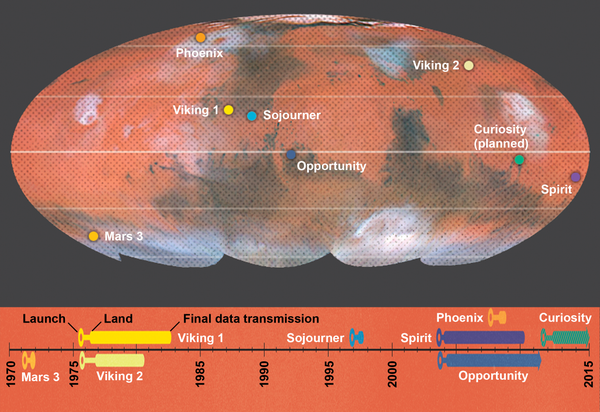
A graphic from the Scientific American archive provides context for this month’s Mars landing attempt

Join Our Community of Science Lovers!

This article was published in Scientific American’s former blog network and reflects the views of the author, not necessarily those of Scientific American


On October 16, Schiaparelli separated from the ExoMars Trace Gas Orbiter spacecraft, and headed towards its final destination, the surface of Mars. Schiaparelli is an Entry, Descent, and landing demonstrator Module (EDM). As such, its lifetime on the red planet will be short—just several days. Scientific instruments will contribute data to the broader ExoMars 2016 mission—a collaboration between the European Space Agency (ESA) and its Russian counterpart Roscosmos—but the craft's main goal is to demonstrate the agencies’ ability to execute a controlled Mars landing.

If successful (the craft is expected to land on October 19), Schiaparelli will be the first ESA spacecraft to operate from the surface of Mars. How have others managed the soft-landing feat? Here’s a graphic from the Scientific American archive (November 2011, nine months before Curiosity rolled onto the planet) that shows how, when, and where previous missions approached the tricky task.


On supporting science journalism

If you're enjoying this article, consider supporting our award-winning journalism by subscribing. By purchasing a subscription you are helping to ensure the future of impactful stories about the discoveries and ideas shaping our world today.


As my colleague Lee Billings (space and physics editor) notes, Schiaparelli uses a hybrid technique to land. Like others shown in the graphic above, “it will first bleed off some speed by aerobraking in the Martian atmosphere, followed by deploying parachutes. And then it will ride down on thrusters, similar to how Phoenix landed. But its final stage is sort of a riff on the airbags approach of Spirit/Opportunity—its thrusters will cut off just a few meters above the surface, and it will fall the rest of the way, landing on an underside specially designed to crush/deform to protect the rest of the spacecraft.” Check out the illustration below for details of the descent strategy, direct from ESA.

Credit: ESA, ATG MEDIALAB

Jen Christiansen is acting chief of design and senior graphics editor at Scientific American, where she art directs and produces illustrated explanatory diagrams and data visualizations. She is also author of the book Building Science Graphics: An Illustrated Guide to Communicating Science through Diagrams and Visualizations (CRC Press). In 1996 she began her publishing career in New York City at Scientific American. Subsequently she moved to Washington, D.C., to join the staff of National Geographic (first as an assistant art director–researcher hybrid and then as a designer), spent four years as a freelance science communicator and returned to Scientific American in 2007. Christiansen presents and writes on topics ranging from reconciling her love for art and science to her quest to learn more about the pulsar chart on the cover of Joy Division’s album Unknown Pleasures. She holds a graduate certificate in science communication from the University of California, Santa Cruz, and a B.A. in geology and studio art from Smith College. Follow Christiansen on Bluesky @jenchristiansen.com

More by Jen Christiansen

It’s Time to Stand Up for Science

If you enjoyed this article, I’d like to ask for your support. Scientific American has served as an advocate for science and industry for 180 years, and right now may be the most critical moment in that two-century history.

I’ve been a Scientific American subscriber since I was 12 years old, and it helped shape the way I look at the world. SciAm always educates and delights me, and inspires a sense of awe for our vast, beautiful universe. I hope it does that for you, too.

If you subscribe to Scientific American, you help ensure that our coverage is centered on meaningful research and discovery; that we have the resources to report on the decisions that threaten labs across the U.S.; and that we support both budding and working scientists at a time when the value of science itself too often goes unrecognized.

In return, you get essential news, captivating podcasts, brilliant infographics, can't-miss newsletters, must-watch videos, challenging games, and the science world's best writing and reporting. You can even gift someone a subscription.

There has never been a more important time for us to stand up and show why science matters. I hope you’ll support us in that mission.

Thank you,

David M. Ewalt, Editor in Chief, Scientific American

Subscribe