
This article was published in Scientific American’s former blog network and reflects the views of the author, not necessarily those of Scientific American
Scientific visualization relies heavily on visual jargon. Symbols can carry highly specific information within a specific context, and allow the illustrator to efficiently communicate complex information with others that are fluent in that language. Flip through any science textbook, and you'll see these symbols rolling out along with new concepts. For example, students learn to interpret and use electron orbital diagrams in chemistry, Feynman diagrams in physics, and cladograms in paleontology.
.jpg?w=1350)
Electron orbital diagrams (Illustration by Jen Christiansen, from “Cracks in the Periodic Table,” by Eric Scerri, in Scientific American, June 2013)
But other than perhaps Feynman diagrams (likely due to the fact that they are named after the person that popularized them), I'm embarrassed to admit that I know very few origin stories of these visual languages. I read or use many of these symbols nearly every day in my job, and yet I don't know the authors.
On supporting science journalism
If you're enjoying this article, consider supporting our award-winning journalism by subscribing. By purchasing a subscription you are helping to ensure the future of impactful stories about the discoveries and ideas shaping our world today.
Last week—thanks to a tweet by Sonya Tadrowksi—I was virtually introduced to another author. The ribbon diagram for representing protein structures was developed by Jane Richardson, currently the James B. Duke Professor of Biochemistry at Duke University.
As Arthur Olson and David Goodsell put it in the 1992 Scientific American article, “Visualizing Biological Molecules,”
"Biochemists often find it enlightening to look at the way a protein chain folds into a compact molecule. Jane S. Richardson of Duke University popularized a simple but effective graphic representation that follows the overall folding of the protein but eliminates the confusing tangle of individual atoms. The resulting ribbon diagram facilitates classifying the many diverse protein structures into a limited number of distinct folding motifs."
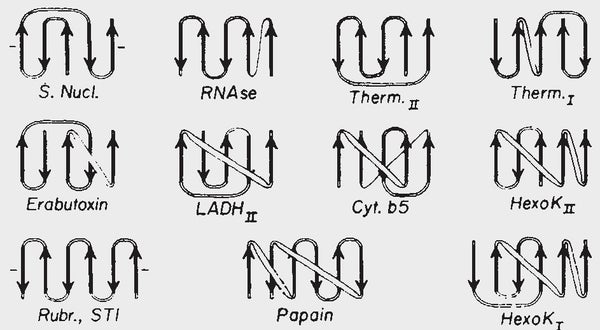
Some early details of Richardson’s classification system were published in "β-sheet topology and the relatedness of proteins." A figure from that paper is shown below.

Figure 1 from "β-sheet topology and the relatedness of proteins" (Reproduced with permission from Macmillan Publishers Ltd: Nature, Vol. 268; August 11, 1977).
An annotated web version of Richardson's "The Anatomy and Taxonomy of Protein Structure" outlines the full classification system (originally published in Advances in Protein Chemistry, Vol. 34, 1981). Also see the slideshow Finding Order, for examples of ribbon diagrams from her lab at Duke.