This article was published in Scientific American’s former blog network and reflects the views of the author, not necessarily those of Scientific American
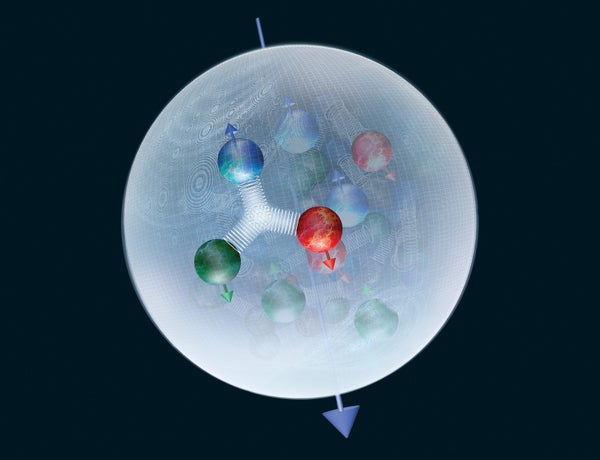
“The particle, known as Xi-cc++ (pronounced “Ksī-CC plus-plus”), is composed of three smaller elementary particles called quarks—specifically, one lighter-weight ‘up’ quark like those found in protons and neutrons and two ‘charm’ quarks, which are a heavier and more exotic variety.”
For context, here’s a peek inside a more familiar particle—the proton—and a visual guide to other theoretical quark-gluon combinations. (For more on gluons and quantum foam, check out “The Mysteries of the World's Tiniest Bits of Matter” by Rolf Ent, Thomas Ullrich, and Raju Venugopalan, from the May 2015 issue of Scientific American).
On supporting science journalism
If you're enjoying this article, consider supporting our award-winning journalism by subscribing. By purchasing a subscription you are helping to ensure the future of impactful stories about the discoveries and ideas shaping our world today.
Credit: Moonrunner Design
Subscribe to Support Independent Journalism
Great science journalism requires human expertise, time, effort and creativity. And it costs money. That’s why I and the journalists here at Scientific American hope you’ll join our community.
When you subscribe, you are supporting staff and freelance journalists who are passionate about telling science stories that are true, important and compelling. Our editors and reporters are often experts in their fields, which means they understand the nuances of big discoveries and can untangle the breakthroughs from the hype. With a subscription, you are also supporting rigorous fact-checking to ensure the words we publish are precise and accurate. And you’re supporting original illustrations, graphics and photos that bring you closer to an advanced laboratory, an ice sheet in Antarctica or a space mission in orbit. You’re helping us craft other types of high-quality journalism as well: Our newsletters are carefully written, edited and curated by staffers you have or will come to know and love. Our Science Quickly podcast is based on original reporting, collaboration with editors and scientists and exacting production.
Subscriptions keep this engine running so we can continue to deliver thoughtful, rigorous and independent science journalism to you. In an era of viral misinformation, this work is crucial. If you value what we do, I hope you’ll consider joining us as a subscriber
Thank you,
Jeanna Bryner, Editor in Chief, Scientific American