
EvolutionJune 1, 2013
Tiny Plants That Once Ruled the Seas
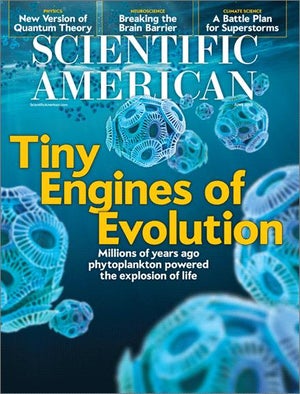
Around 250 million years ago animals in the seas began to diversify with gusto. Remarkably, the evolution of minute plants known as phytoplankton probably powered that dramatic explosion
You are currently logged out. Please sign in to download the issue PDF.
Tiny Plants That Once Ruled the Seas
Around 250 million years ago animals in the seas began to diversify with gusto. Remarkably, the evolution of minute plants known as phytoplankton probably powered that dramatic explosion
Can Quantum Bayesianism Fix the Paradoxes of Quantum Mechanics?
A new version of quantum theory sweeps away the bizarre paradoxes of the microscopic world. The cost? Quantum information exists only in your imagination
“Messing with” the Blood-Brain Barrier May Be Key to Treating a Host of Diseases
A new understanding of the blood-brain barrier as a living, mutable organ may revolutionize the treatment of diseases such as cancer and Alzheimer's
New York City and the U.S. East Coast Must Take Drastic Action to Prevent Ocean Flooding
New York City and the entire U.S. East Coast could face frequent destruction unless the region takes significant preventative measures
Cracks in the Periodic Table
The discovery of element 117 filled the last remaining gap in the periodic table as we know it. But even as it is being completed, the table may be losing its power
Tree Rings Tell a Tale of Climates Past
Trees tell a tale of changing climate
Psychologists Find New Ways to Steel Minority Students against Fear of Failure
Even subtle reminders of prejudice against one's sex, race or religion can hinder performance in school, work and athletics. Researchers have found new ways to reverse and prevent this effect
How to Build a Smarter Internet
To keep the Web from collapsing under the weight of ever more data, the network needs to radically change the way it handles information, says the head of Bell Labs Research