

Shayla Love: This is Scientific American’s 60-Second Science. I’m Shayla Love.
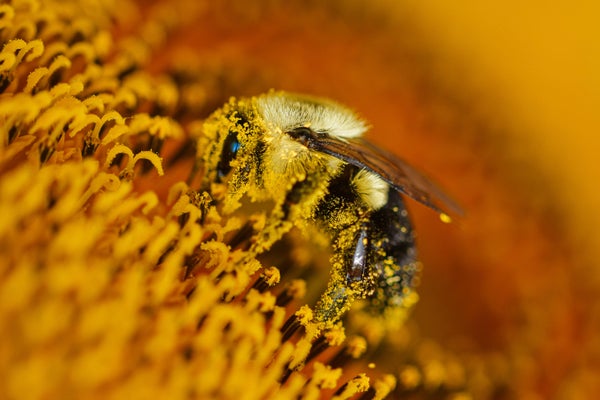
When you hear a bee buzzing along, visiting a flower, you’re hearing the movement of air made by the fluttering of its wings. But it turns out that bees are buzzing in more than one way.
Giles Harrison: I first saw this when I saw a bumblebee land on an electrode I was using, and I saw a real change in the measurement. And I thought, “This is a charged thing.”
On supporting science journalism
If you're enjoying this article, consider supporting our award-winning journalism by subscribing. By purchasing a subscription you are helping to ensure the future of impactful stories about the discoveries and ideas shaping our world today.
Love: That’s Giles Harrison, a professor of atmospheric physics at the University of Reading in England. He’s co-author of a recent paper in iScience that measured the electric charge of swarms of bees and found that the insects can generate as much electricity as storm clouds.
Ellard Hunting: We’ve known for quite a long time already that bees carried an electric charge.
Love: Ellard Hunting is a biologist at the University of Bristol in England, and he studies how different organisms use those electric fields in the environment. Plants and pollen tend to be negatively charged, and bees are positively charged.
Hunting: The bee visits a flower, and the pollen is actually electrostatically attracted to the bee, and so they stick better and they transfer better.
Love: There are several honeybee hives that are used for research at the field station at the University of Bristol’s school of veterinary sciences. Those bees sometimes swarm, and that’s when the researchers were able to directly measure them using an electric field monitor.
Bees can also electrically sense whether a flower has been visited by another bee who already took its nectar. But until now, it hadn’t been considered that living things flying around in the atmosphere could make an impact with their own charges.
Now, an individual bee’s charge is minuscule: it takes a lot of bees to generate enough electricity to make an impact.
Hunting: Imagine that you need a billion of those to light up an LED.
Harrison: Fifty million million bees to get enough charge to start a car.
Love: But altogether, because there are so many insects in the atmosphere, theycan have a massive effect.
This means that bees and other large groups of insects are capable of changing the atmospheric electric fields around them—potentially impacting things such as weather events, cloud formation and dust dispersal.
Insects are not the only living thing that spends time in the atmosphere. Birds and microorganisms carry charge, too, and take up space in the lower atmosphere.
Even before the bees were measured, we knew the sky was filled with electricity. These static electric fields are found everywhere in Earth’s atmosphere. And they can be swayed by rain, lighting, aerosols, pollution, volcanoes and possibly earthquakes.
Atmospheric electricity is measured as something called the vertical potential gradient, or PG, which is the difference in voltage between the surface of Earth and any point in the air. The team found the swarms of bees could change the PG by 100 to 1,000 volts per meter.
They also modeled how atmospheric electricity might be impacted by other insects, such as desert locusts, which can form swarms of up to 460 square miles. These swarms are dense enough to cram 40 million to 80 million of the insects into less than half a square mile. Based on past measurements of locusts’ electric charges, such swarms create more charge than those reported for electrical storms.
Not all insects pack such an electrical punch. In the modeling, moths and butterflies don’t seem to have a big impact because of their low densities.
Right now insects’ electric charges aren't accounted for in climate models that look at complex interactions in the atmosphere. They probably should be: the combined electric charge of all these insects might impact the development of rain, snow, and droplet formation and maybe even how clouds are made.
Hunting: We can only speculate, but, like, that might have an impact on cloud formation. If there’s a direct link between insects and cloud formation, then we know that clouds are relevant to climate.
Love: Insect electricity could also be influencing how dust moves around the atmosphere. This is something that atmospheric scientists are interested in because such dust cuts off incoming sunlight and can change temperature distributions locally.
Harrison: The link between dust and insects is very interesting because one of the questions in climate change is “How is it that large particles move from the Sahara?” And we just thought about it in terms of the physics of transporting them from the Sahara. What if they’re stuck to a locust because they’re charged? That really changes things, and we could think about it very differently.
Love: After learning about how much of a spark these insects can generate together, it may be time to start taking into account all that extra buzzing up in the air.
For 60-Second Science, this is Shayla Love.
[The above text is a transcript of this podcast.]
