

Emily Schwing: This is Scientific American’s 60 Second Science. I’m Emily Schwing.
When he was little, Alessandro Chiarenza’s grandmother used to read him bedtime stories about dinosaurs and she would always tell him the same thing.
Alessandro Chiarenza: Oh you know, but these things were not living here. They were living in like America and in Asia, but not here in Italy.
On supporting science journalism
If you're enjoying this article, consider supporting our award-winning journalism by subscribing. By purchasing a subscription you are helping to ensure the future of impactful stories about the discoveries and ideas shaping our world today.
Schwing: That bedtime story first began to change for Italian kids back in the 1990’s.
Chiarenza: We have found plenty of dinosaur records from dinosaur fossils. We started in the past decades to record the footprints, but then most importantly, we started finding bones and now, now complete skeletons of dinosaurs.
Schwing: Chiarenza, a paleontologist at the University of Vigo in Spain, is part of a team that recently uncovered nearly a dozen complete dinosaur skeletons - a first in Italy. The discovery is documented in the journal Scientific Reports. And it once again upends the bedtime story, so to speak. [Alfio Alessandro Chiarenza et al, An Italian dinosaur Lagerstätte reveals the tempo and mode of hadrosauriform body size evolution]
Chiarenza: Usually, you don’t find multiple complete individuals altogether. It’s something historically very rare.
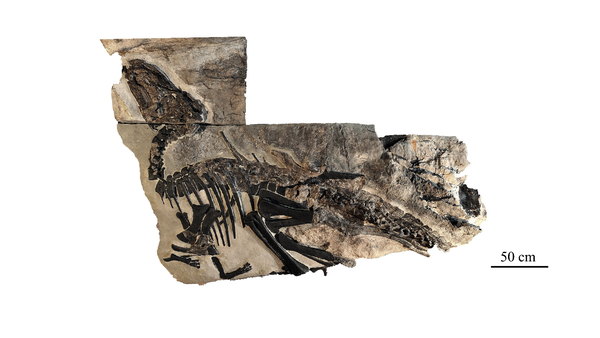
Schwing: Back in 1994, in Trieste, a municipality in North Eastern Italy, scientists discovered Antonio - a small hadrosaur, or duck-billed dinosaur. The skeleton is about three and a half meters long—the size of a small SUV— and very well preserved.
Chiarenza: And one peculiar feature from this dinosaur stage was relatively small from the close cousins that they were inhabiting at the time in North America and Asia and these, these dinosaurs from these exotic lands would be quite big at the time. they’re basically coexisting with the T-Rex or relatives of the T-Rex. These were like the main predators of these animals and so they were quite big.
Schwing: When he was discovered, scientists theorized that Antonio was a victim of something called the “island rule.” The site of Antonio’s discovery—Villaggio Del Pestacore—was once part of an island that sat in the middle of a proto-Mediterranean sea, known as Tethys. In fact this is how Antonio came to acquire his scientific name: Tethyshadros insularis. Insularis means “from an island,” according to Chiarenza. And as the old story goes, Antonia would have been a ‘dwarf’ species because of limited resources on that island.
But this all changed when Bruno, a hadrosaur of the same species was discovered.
Chiarenza: We know that if you cut a dinosaur skeleton, you can see some structure which is more comparable or analogous to what you see in a tree ring, so you count them and you can see how old these animals are. And we realized that the bigger skeleton, which was named Bruno, was older in age than the younger one, the skeleton of Antonio, the one that was smaller in size.
Schwing: Antonio is roughly the size of a small car SUV, but Bruno is a meter longer - closer to the size of a larger minivan.
Chiarenza: So Antonio is a complete skeleton and Bruno, it's 70 to 75 percent complete. There is another skeleton which is still on the ground and waits to be discovered to be completely recovered and prepared. And this is actually—it's nicknamed Rocco and is potentially even bigger than Bruno.
Schwing: The discovery of Bruno and Rocco have totally upended Antonio’s story. And so have other findings at the site.
Chiarenza: Dinosaurs were not the only fossil remains from the area. We also find shrimps, plants. We find crocodiles. We find all sorts of dinosaurs which still are pending proper descriptions, flying reptiles like pterosaurs.
Schwing: Chiarenza says he also imagines the region as a marginal marine area.
Chiarenza: There were probably more mainland connections, so you would have found this vegetated beach surrounded by like a little bit of higher ground, then more vegetated and forested areas that we're sort of going towards continental Europe. And you probably would have seen these dinosaurs like Tethyshadros potentially moving together, like in a group, maybe drinking in, you know, on a river side.
Schwing: The team also collected new data on the geology of the area. They redated the rocks to 80 million years ago, which is 10 million years older than thought.
Chiarenza: Which also led us to think that at the time, the paleogeography of the area was actually different. It wasn’t the islands archipelago that it was speculated before But it was actually a more continuous with larger, more extended land masses that probably we're offering up connections between not only the western part of Europe and the eastern part of Europe, but with also Asia and eventually Africa. So it probably was supporting more population of larger animals that had more available resources.
Schwing: So what comes next in the new version of this Italian dinosaur saga? Chiarenza says he’s particularly interested in looking at what he and colleagues can learn from past changes in climate.
Chiarenza: Trying to learn which species might have been more sensitive to some climate change and trying to infer what did that might meant for their adaptations.
Schwing: He says the next chapter in this story will be to parse out how changes in climate over time drove the distribution of dinosaurs across Europe, into Asia and in other parts of the world.
For 60 Second Science, I’m Emily Schwing.
