

Emily Mullin: This is 60-Second Science. I’m Emily Mullin.
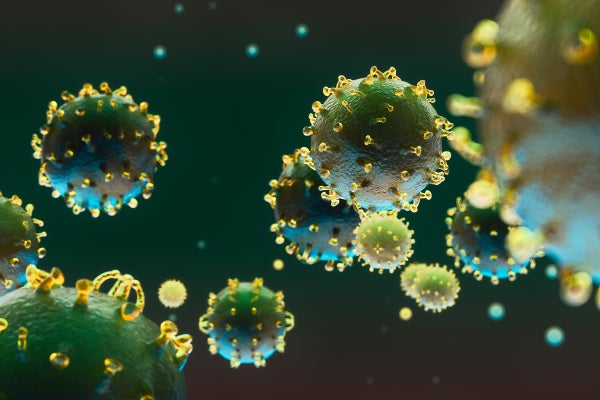
In the past 20 years alone, three coronaviruses have caused major disease outbreaks. First came the original SARS virus in 2002. Then, in 2012, MERS was identified. In 2019 SARS-CoV-2 emerged, setting off a global pandemic.
Hundreds of other coronaviruses are known to be circulating in bats and other animals. Scientists have warned that some of them could emerge in the future and potentially infect people. Our current COVID-19 vaccines were specifically designed for SARS-CoV-2, but what if a next-generation vaccine could protect against both known and unknown coronaviruses?
On supporting science journalism
If you're enjoying this article, consider supporting our award-winning journalism by subscribing. By purchasing a subscription you are helping to ensure the future of impactful stories about the discoveries and ideas shaping our world today.
Scientists at the Walter Reed Army Institute of Research in Silver Spring, Md., are working on a so-called universal coronavirus vaccine. Dr. Kayvon Modjarrad is leading the effort.
Kayvon Modjarrad: We’ve developed a vaccine specifically for SARS-CoV-2. But what we’ve seen in our animal studies is that the immune response that it induces is active against all the variants, as well as other coronaviruses like SARS-CoV-1 that was seen back in 2002. And this gives us confidence that it can be a platform for the entire coronavirus family.
Mullin: Before COVID-19, Modjarrad and his Army colleague Gordon Joyce were trying to develop a universal vaccine against a group of viruses that includes Lassa virus, which is similar to Ebola.
Modjarrad: And so, when the new coronavirus was identified as a coronavirus, and the sequence was published January 10 of 2020, that night, Dr. Joyce and I had a late-night conversation about turning, pivoting, our work that had been ongoing for other viruses toward this coronavirus and toward coronaviruses as a whole.
Mullin: Their vaccine is known as a spike ferritin nanoparticle, or SpFN for short. It combines nanoparticles from a blood protein called ferritin with coronavirus spike proteins. It works by presenting the immune system with the spike protein in a repetitive, ordered fashion. All coronaviruses have these spike proteins on their surface.
But making the vaccine wasn’t as simple as attaching one protein to another. Modjarrad and his colleagues had to figure out which parts of the spike to attach to which type of ferritin and how to link the two proteins together. It took months of trying more than 200 different combinations.
By June of last year, the team found one version that succeeded where others had failed. They then tested the experimental vaccine in mice, hamsters and monkeys.
The team also turned to less conventional animals for testing. Working with scientists in India, they injected horses with the vaccine to learn how strong the immune response was. And they collaborated with Helen Dooley at the University of Maryland to vaccinate sharks—which make special antibodies.
Modjarrad: We saw the same thing over and over again, regardless of which animal species we were testing it in.
Mullin: The vaccine produced a potent immune response against the original SARS-CoV-2 strain and three of its variants. The animals also developed antibodies against the 2002 SARS virus.
The results are encouraging, but animals aren’t people. The Army vaccine is now being tested in a small, early-stage trial in humans. If it works and is safe, it could lay the foundation for a universal coronavirus vaccine.
Modjarrad: The deadly coronaviruses—like SARS-1, MERS and now SARS-2—have all come from animal populations, and there’s a strong expectation that this pattern is not going to end anytime soon. So we have to have a platform positioned to anticipate the emergence of new coronaviruses.
Mullin: But Modjarrad says it’s going to take sustained interest and investment from the government and pharmaceutical companies to get a vaccine like this ready in time for the next pandemic.
Modjarrad: Our species has a tendency to get distracted. We have a very strong appetite for distraction, and when something is not in the spotlight, when it’s not a crisis anymore, we tend to forget and move on to something else. So the biggest challenge is going to be maintaining focus on this next step of developing vaccines that anticipate pandemics.
Mullin: For the 60-Second Science Podcast, I’m Emily Mullin.
[The above text is a transcript of this podcast.]
