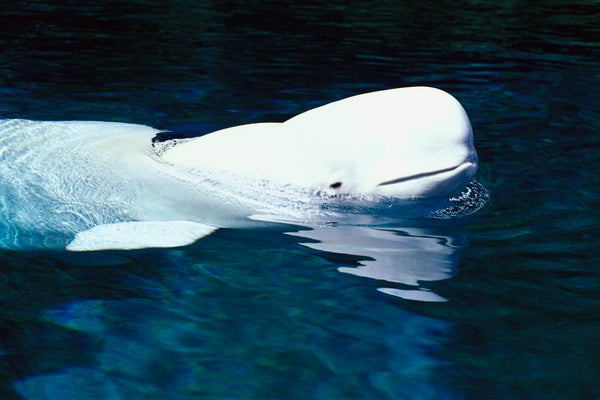
Beluga whales rely on a sharp sense of hearing to communicate, to navigate and to feed. But the ocean is a noisy place. There's commercial shipping, navy sonar, oil and gas extraction, pile driving, underwater explosions.
One way to tell if all that noise is affecting belugas: capture them for a routine physical. "So it's kind of like going to the doctor's office for them, but they're also kind of abducted by aliens at the same time."
Aran Mooney, a marine biologist at the Woods Hole Oceanographic Institution. He and his team captured 26 belugas in Alaska's Bristol Bay for a battery of checkups, including a hearing test.
On supporting science journalism
If you're enjoying this article, consider supporting our award-winning journalism by subscribing. By purchasing a subscription you are helping to ensure the future of impactful stories about the discoveries and ideas shaping our world today.
"We can play a very controlled, designed sound to the animal, a hearing test tone." Then they measured the beluga's brain response using an electrode on the animal's head.
The diagnosis? "They're doing fantastic—and they're better than what we thought they were going to be." And older belugas seemed to have less age-related hearing loss than aging dolphins screened in previous studies. The full bill of health is in the Journal of Experimental Biology [T. Aran Mooney et al., Variation in hearing within a wild population of beluga whales (Delphinapterus leucas)].
These belugas live in a relatively pristine environment, which might explain why they aced the hearing test. Animals in noisier waters might not fare so well, Mooney says. And the same might go for belugas as the volume slowly rises in the underwater Arctic.
—Christopher Intagliata
[The above text is a transcript of this podcast. Beluga sounds provided by Manuel Castellote and Aran Mooney.]
Subscribe to Support Independent Journalism
Great science journalism requires human expertise, time, effort and creativity. And it costs money. That’s why I and the journalists here at Scientific American hope you’ll join our community.
When you subscribe, you are supporting staff and freelance journalists who are passionate about telling science stories that are true, important and compelling. Our editors and reporters are often experts in their fields, which means they understand the nuances of big discoveries and can untangle the breakthroughs from the hype. With a subscription, you are also supporting rigorous fact-checking to ensure the words we publish are precise and accurate. And you’re supporting original illustrations, graphics and photos that bring you closer to an advanced laboratory, an ice sheet in Antarctica or a space mission in orbit. You’re helping us craft other types of high-quality journalism as well: Our newsletters are carefully written, edited and curated by staffers you have or will come to know and love. Our Science Quickly podcast is based on original reporting, collaboration with editors and scientists and exacting production.
Subscriptions keep this engine running so we can continue to deliver thoughtful, rigorous and independent science journalism to you. In an era of viral misinformation, this work is crucial. If you value what we do, I hope you’ll consider joining us as a subscriber