

On supporting science journalism
If you're enjoying this article, consider supporting our award-winning journalism by subscribing. By purchasing a subscription you are helping to ensure the future of impactful stories about the discoveries and ideas shaping our world today.
Homo sapiens may dominate Europe and Asia today. But hundreds of thousands of years ago—long before we got there—the land was ruled by our now-extinct cousins, the Neandertals and Denisovans. "One important thing to realize is that, given that Neandertals and Denisovans had lived in Europe and Asia for such an extended time they were probably quite well adapted to the local conditions." Janet Kelso, a computational biologist at the Max Planck Institute for Evolutionary Anthropology. "So they were well adapted to the pathogens, to the foods that were available, to the climate."
The invading newcomers probably found themselves less well adapted to the local conditions. So when H. sapiens shacked up with their close evolutionary relatives, it gave them a shot at picking up some advantageous genes.
Kelso and her colleagues hunted modern human genomes for strings of DNA that closely resembled those known to be from Neandertals and Denisovans. And indeed, on human chromosome number four they found a stretch of archaic DNA, 140,000 bases long.
The genomes of many non-African humans today have this sequence, which includes a cluster of genes that code for Toll-like receptors, or TLRs—a type of immune protein that sniffs out pathogens. And it turns out that archaic variants of that gene are associated with lower microbial loads in present-day humans—a trait that may have been quite valuable to our ancestors as they settled new lands. The study appears in the American Journal of Human Genetics. [Dannemann et al, Introgression of Neandertal- and Denisovan-like Haplotypes Contributes to Adaptive Variation in Human Toll-like Receptors]
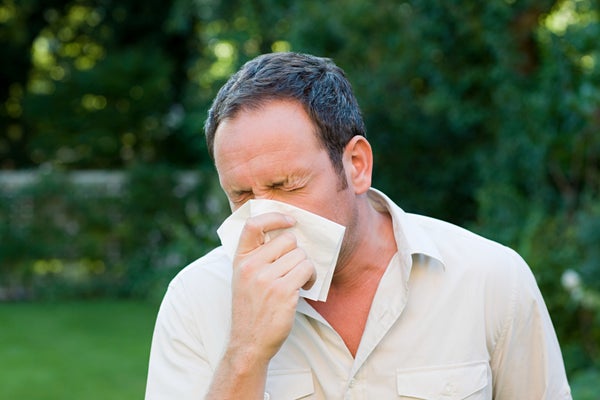
Problem is, that increased immune vigilance has a side effect: allergies. “Our speculation is that this is some kind of trade-off, right? In the past you needed to resist some kind of pathogen, and the trade-off or sacrifice you have to make for that is some increased responsiveness to nonpathogenic allergens." So next time some of you get the springtime sniffles, blame your distant ancestor—the one with the heavy brow ridge.
—Christopher Intagliata
[The above text is a transcript of this podcast.]
