
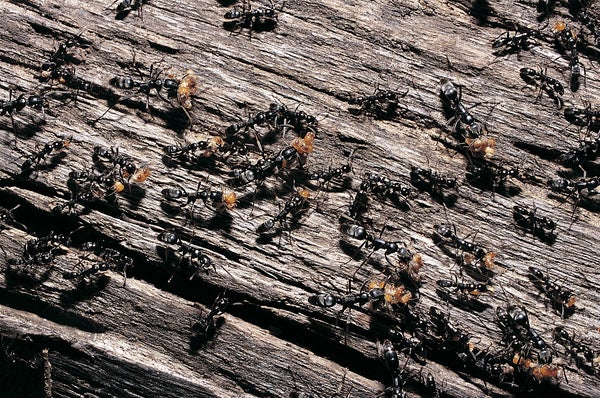

It’s peak cold and flu season, which means taking a lot of preventive measures. Frequent hand-washing is a must. As is avoiding co-workers or friends who are sick. But we humans are not the only animals that change behavior to keep diseases at bay. So do ants.
“So there are the foragers and the nurses– it's two different groups of work.”
Nathalie Stroeymeyt of the University of Lausanne. She and colleagues observed ants to see their reaction to the presence of a pathogen.
On supporting science journalism
If you're enjoying this article, consider supporting our award-winning journalism by subscribing. By purchasing a subscription you are helping to ensure the future of impactful stories about the discoveries and ideas shaping our world today.
“With the nurses staying inside the nurse taking care of the brood and being made of young workers. And the foragers are all the workers at outside of the nest to collect food and defend the territory.”
Forager ants are at greater risk of getting exposed to diseases because they leave the safety of the nest. So the researchers sprayed a common fungus on a small group of forager ants and then followed their movements to see the way other ants reacted.
“We marked all ants in the colony was individual labels, which carries these two-dimensional bar code marks like QR code which is automatically detected and recorded using a tracking system.”
After the infection, the nurse and forager ants stayed within their cliques and interacted less outside of their work group. The researchers also saw that forager ants spent more time outside of the nest.
“They increase that amount by 15 percent so by quite a long large amount.”
The researchers also measured the amount of fungus on each ant and saw that it was almost completely contained within the foragers group. Some nurse ants and even the Queen did have trace amounts of the fungus’ spores on them but the amount was small enough that they could easily groom them off of their bodies. The study is in the journal Science. [Nathalie Stroeymeyt et al., Social network plasticity decreases disease transmission in a eusocial insect]
Not only does the cliquish behavior stop the spread of the fungus, “but it allows you to develop immunization. Something that's quite interesting in these ants that's been shown by other study is that when you receive very small amount of these spores, you don't have an increase in mortality risk because it's low enough that you can heal, it's sort of boost your immune defenses and protect you against later exposure to the same pathogen.
Seems that in their ability to avoid infecting other members of the community, ants may be more advanced than we are.
—Lucy Huang
[The above text is a transcript of this podcast.]

