

Emily Schwing: This is Scientific American’s 60-Second Science. I’m Emily Schwing.
Imagine this: you’re in a lab in Indiana. Your arm is stuck in a box. The box is filled with bloodthirsty insects. And those insects? Well, they intend to feed on you.
Giles Duffield: The staff scientist who works with me, Dr. Samuel Rund, he has a very good arm that he doesn’t mind exposing to mosquitoes to feed off him.
On supporting science journalism
If you're enjoying this article, consider supporting our award-winning journalism by subscribing. By purchasing a subscription you are helping to ensure the future of impactful stories about the discoveries and ideas shaping our world today.
Schwing: Notre Dame Professor Giles Duffield convinced a colleague to play the role of blood meal for his research on mosquito genetics and behavior. It’s published in the American Journal of Tropical Medicine and Hygiene. [Samuel S. C. Rund et al., Artificial light at night increases Aedes aegypti mosquito biting behavior with implications for arboviral disease transmission]
Duffield cared less about whether his colleague would be delicious—that was obvious. What he really wanted to know was—like humans kept awake by the light of their cell phones—would artificial lighting keep mosquitoes up and biting deep into the night?
So Duffield and his colleagues created an experiment: they’d monitor the biting behaviors of mosquitoes who had been exposed to pulses of artificial light throughout the night.
Duffield: It doubled their biting activity, the feeding activity. And so, obviously, this could have big implications. So the effect on the biting at night was the levels of biting were approaching those that we would see during the late afternoon, when we expect to see that peak biting. So it’s not a small change. It’s a very robust increase in the biting behavior.
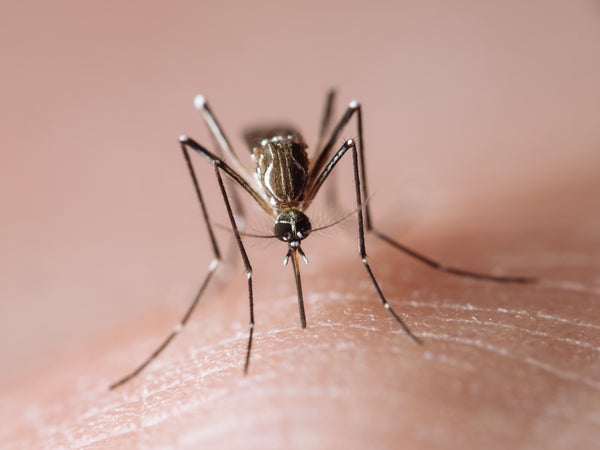
Schwing: There are a number of different species of mosquitoes, and they behave in different ways. Some bite only at night, others are daytime feeders. But there’s one species in particular that Duffield and colleagues were focused on: Aedes aegypti.
Duffield:Aedes aegypti sort of evolved alongside humans and is very adept to living within human habitation. So any sort of environmental changes that would influence its feeding and biting behavior could have huge ramifications on humans, probably more than any other mosquito species.
Schwing: Duffield says Aedes aegypti are the major vector for the human transmission of diseases like encephalitis, chikungunya, malaria, dengue fever and the Zika virus: all diseases that have made headlines in recent years.
And that’s why he needed his colleague’s arm.
Duffield: We feel as though this is a nice, simple assay. And it represents a more natural stimulus for the mosquito: carbon dioxide, odorant smells, body temperature, the attraction to warmth, and the physical skin and the chemicals that are released from the skin. So it certainly represents a more natural host-mosquito-biting response. But yeah, it's unfortunate for those who are the investigators. When you get 30 mosquito bites per assay, it’s painful sometimes.
Schwing: The next step is to look at how different species of mosquitoes respond to different kinds of light.
Duffield: Yeah, so that’s something that we’re busy trying to investigate right now: In the original experimentation, we just use broad-spectrum white light. And as we fine-tune current and future experiments, we’re interested in seeing if specific wavelengths, or color, color spectrums of light, have the same effect or less effect.
Schwing: And Duffield has some ideas.
Duffield: So possibly the brighter the light, the larger the effect. But again, you may find extremely bright light inhibits the mosquito. So it may be a sort of sweet spot in the intensity of light, the illuminance.
Schwing: He says the color of light and the time of the night when mosquitoes are exposed to light are also parameters worth exploring. He’s also interested in studying different species of bloodsucker. Not all mosquitoes feed at night. Since some are day feeders, it raises the question of whether artificial light at night would affect them at all.
Eventually, the goal is to figure out if they can make recommendations on how people in mosquito-prone parts of the world should light their homes.
In the short term, though, future findings will hopefully disarm hungry mosquitoes—while preserving the arms of the study subjects they feed on.
For 60-Second Science, I’m Emily Schwing.
[The above text is a transcript of this podcast.]
