
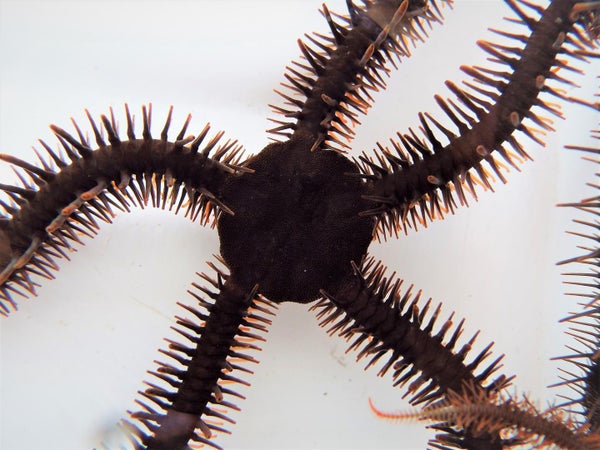

Brittle stars are close relatives of starfish with a much more delicate appearance.
“So if you imagine a starfish with really skinny, spiny arms, made up of lots of little articulated plates, that’s kind of what a brittle star looks like—a cross between a millipede and a starfish, I guess.”
Lauren Sumner-Rooney is a visual ecologist at Oxford University. One of the brittle star species she studies, Ophiocoma wendtii, also has color-changing superpowers.
On supporting science journalism
If you're enjoying this article, consider supporting our award-winning journalism by subscribing. By purchasing a subscription you are helping to ensure the future of impactful stories about the discoveries and ideas shaping our world today.
“If you catch one of these animals during the day, they’re a really beautiful reddish brown, dark brown color. If you actually go out again at night and collect the same animal, they’re this very pale beige with dark stripes.”
The reason for that color shift was murky—perhaps for UV protection or camouflage. But now Sumner-Rooney’s team has come up with a possible answer: that red coloration might help the brittle stars sort of see, even though they have no eyes. In bright daylight, their redness filters the light reaching photoreceptors along their arms.
Brittle stars like hiding in shady parts of the reef. So the researchers placed the brittle stars in an environment with black-and-white-patterned walls, aimed at testing whether the creatures were simply light sensitive—which isn’t the same as vision—or if they could truly see.
The vision test involved a black vertical bar centered on a white vertical bar twice the width. The nearby walls were 50 percent gray. Without true vision, the black-and-white-patterned area would simply come across as 50 percent gray, and you wouldn’t expect the brittle stars to consider that part of the arena a good hiding place.
Instead the brittle stars flocked towards the pattern—suggesting they have at least rudimentary visual skills. But strangely, the creatures lost this ability when they turned from red to beige. After doing digital reconstructions of the visual system, the researchers determined that perhaps the reddish pigments limit the angles of light reaching photoreceptors along the animals’ arms—thus improving the resolution of the brittle stars’ vision and allowing them to, in their own way, “see.”
The results are in the journal Current Biology. [Lauren Sumner-Rooney et al., Extraocular vision in a brittle star is mediated by chromatophore movement in response to ambient light]
So far, one species of sea urchin has also been shown to have this visual ability without true eyes, and it, too, changes color.
“There could be countless other examples of weird and wonderful visual systems that we have no idea are there—simply because, you know, this animal, looking at it, you can't find ‘an eye,’ a single discrete visual organ. And there are so many other animals like that that could be using vision, we just haven’t looked in the right place yet.”
In other words, when it comes to seeing, the eyes don’t always have it.
—Christopher Intagliata
[The above text is a transcript of this podcast.]
