
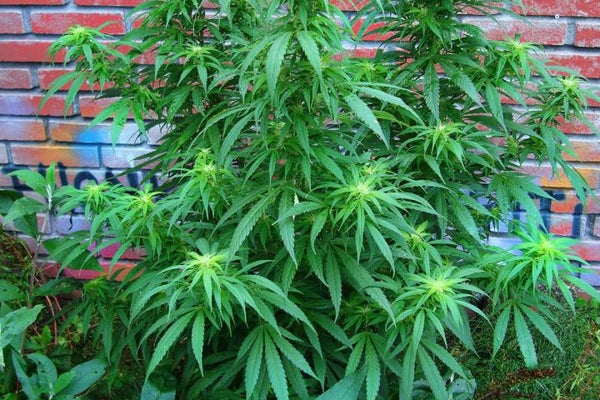

The compounds THC and CBD are known as cannabinoids, because they come from cannabis. AKA marijuana. Now biologists have taken the genes that produce cannabinoids in weed, and plugged them into: yeast.
"Yeah—there's several reasons. The first is cost." Jay Keasling is a synthetic biologist at U.C. Berkeley, who has previously programmed yeast to cheaply produce antimalarial drugs. He says yeast could conceivably produce cannabinoids for about $400 a kilogram—compared to the $40,000-a-kilo price tag when using synthetic chemistry.
Other benefits exist, too: "There are about 100 different cannabinoids that naturally occur in cannabis but it's been hard to do research on those because there's not much available. They are produced in such minute quantities in the cannabis you'd have to purify a huge amount of cannabis just to get enough to test."
On supporting science journalism
If you're enjoying this article, consider supporting our award-winning journalism by subscribing. By purchasing a subscription you are helping to ensure the future of impactful stories about the discoveries and ideas shaping our world today.
Keasling says they can even make cannabinoids that don't exist in nature at all, by feeding the yeast certain fatty acids. The resulting cannabinoids, which are chemically similar but not identical to garden-variety THC and CBD, have little appendages the scientists can do chemistry on.
"We could attach an antibody to it and get it to go to a certain location in the human body based on the antibody. We could also put a tail on it so it could be put on a patch and cross the skin, and be used like the nicotine patches. We could also put another drug on it so you'd have a dual therapy. And this is something that kind of came out of the research that we didn't expect."
The research is in the journal Nature. [Xiaozhou Luo et al., Complete biosynthesis of cannabinoids and their unnatural analogues in yeast]
Keasling has already founded a new company—Demetrix—to study these yeast-produced medicines. But there are also more mundane things you could do with this technology. Many people are already enthusiasts of the fermented beverages yeast produce. A certain segment of them may also be fans of cannabinoids. With this technology, Keasling says you could produce a THC or CBD beer. Which would give a new meaning to, "This Bud's for You."
—Christopher Intagliata
[The above text is a transcript of this podcast.]
