

In January 2014, an epic cold wave swept across the southeast—a "snowpocalypse" so severe that thousands of drivers in Atlanta abandoned their cars on icy highways and Interstates.
"And I'm from the south, I was raised in South Carolina, and I can tell you that in the South we do not do cold—at all."
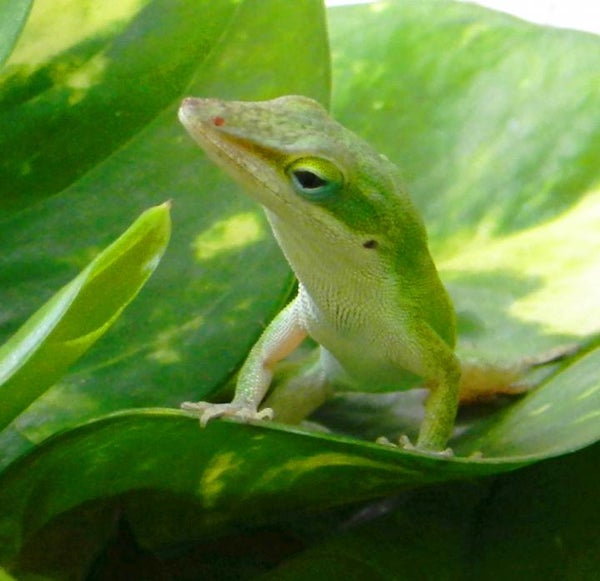
Shane Campbell-Staton was watching it all unfold from Harvard, where he was getting his PhD. He'd just wrapped up his last field season in Texas, studying the green anole lizard. And as he was scanning photos of the storm, he came across something unexpected: a photo that included his research subject.
On supporting science journalism
If you're enjoying this article, consider supporting our award-winning journalism by subscribing. By purchasing a subscription you are helping to ensure the future of impactful stories about the discoveries and ideas shaping our world today.
"There was this one picture of a green anole that was upside down, dead in the snow. And it was sort of a Eureka moment. And I thought to myself, well maybe I should go back out and see if these populations I'd been studying, if they showed any sort of response to this pretty extreme weather event in the south."
And so that's what he did. Because here's the bit of serendipity: he'd actually been studying the cold tolerance of different populations of these lizards. And the cold snap had just delivered the perfect experiment—a chance to see natural selection in action.
"So I went back in April right after these winter storms had subsided. And I noticed that in the south, the southernmost population, the survivors of the storm were able to maintain function at significantly colder temperatures than the population before the storm. And this ability to maintain function at colder temperatures is something we typically see much farther north."
He did genetic analyses too: and found that the genes switched on in the surviving southern lizards overlapped with genes more typically turned on in their cold-hardy northern cousins. And the survivors also carried variations in their DNA that more closely matched northern lizards. So three things: cold tolerance, gene expression, and even the gene variants the southerners carried, suggested this winter storm had indeed caused selection on the southern lizards. The analysis is in the journal Science. [Shane C. Campbell-Staton et al., Winter storms drive rapid phenotypic, regulatory, and genomic shifts in the green anole lizard]
Campbell-Staton, now at the University of Illinois and the University of Montana, is quick to mention that this isn't quite evolution yet. It's just one generation—he hasn't yet seen these traits passed down to another set of lizards. That's his next investigation.
As for whether this is a good thing, the fact that some lizards were able to summon the ability to survive cold? "The answer is both yes and no potentially." Yes, because if another cold wave rolls through, the surviving southern population will be better prepared—more cold-tolerant.
But: "We know that selection comes at a cost. Which is death. So the individuals that died during this event may have had genetic variants that would have allowed them to survive a heat wave, or a drought, or some other extreme event. And now those lineages are essentially gone."
The long term forecast for the 21st century includes more of these extreme events—and more severe ones at that. So species that lose their genetic Swiss army knife of adaptive tools may, again, be left out in the cold.
—Christopher Intagliata
[The above text is a transcript of this podcast.]
