
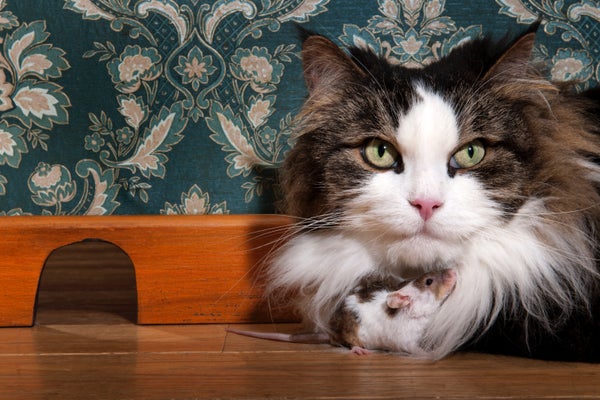

Parasites live on or even inside another organism. And some can even change the behavior of their host to boost the odds of their transmission. Take the single-celled Toxoplasma gondii. Mice infected with this bug appear to become attracted to the smell of cat pee, an odor that uninfected mice smartly avoid. The infection thus raises the chances that a mouse will wind up in a cat’s mouth. Obviously, bad news for the mouse—but good news for the parasite, which needs a kitty to complete its life cycle and spread to additional hosts.
Devious, indeed. But it turns out this cunning scheme may be less precisely targeted than it initially appears—because a new study finds that Toxoplasma doesn’t specifically eliminate a mouse’s natural aversion to cats. Rather the infection makes them generally less anxious and more adventurous—which makes them them curious about cats and pretty much everything else. Their work appears in the journal Cell Reports. [Madlaina Boillat et al., Neuroinflammation-associated aspecific manipulation of mouse predator fear by Toxoplasma gondii]
“The story about Toxoplasma gondii manipulating the behavior of its host is simply fascinating.”
On supporting science journalism
If you're enjoying this article, consider supporting our award-winning journalism by subscribing. By purchasing a subscription you are helping to ensure the future of impactful stories about the discoveries and ideas shaping our world today.
Biologist Ivan Rodriguez of the University of Geneva, one of the study’s senior authors.
“It was particularly intriguing for us to understand how the parasite achieves a specific alteration of the neural circuits involved in the response toward feline predators—something that has never been elucidated.”
So Rodriguez and his colleagues set out to determine the molecular mechanisms that underlie this legendary feline fatal attraction. For their first step:
“We decided to perform a quite broad panel of behavioral assays with infected mice in order to get an overview of how the parasite affects its host. We quickly observed that infected mice were less anxious, were more explorative and reacted quite differently than control mice when confronted with potential threats.”
For example, mice infected with Toxoplasma were quicker to check out the far reaches of an elevated maze than their uninfected comrades. They interacted with the human investigators’ hands and were unperturbed when an anesthetized rat was plonked into the middle of their cage—an event that caused uninfected mice to freeze in their tracks.
And the infected mice in this study did indeed show an attraction to the urine of bobcats. But they were even more interested in the scents of foxes and guinea pigs. Of course, whether or not infected mice are drawn specifically to the smell of cats, the parasite still gets what it wants, says Rodriguez.
“The end result is to favor the transmission of the infected rodent to the cat.”
As to the mechanism, it appears that the parasite triggers a general inflammation of the brain.
“One interesting finding is that we observe a correlation between the level of inflammation and the severity of behavioral alterations.”
Madlaina Boillat, a graduate student in the Rodriguez lab.
She and Rodriguez will continue to explore how neuroinflammation sends mice to their almost certain doom. Does it render these mice blind to danger—or endow them with the kind of curiosity that is usually associated with their feline foes?
—Karen Hopkin
[The above text is a transcript of this podcast.]
