
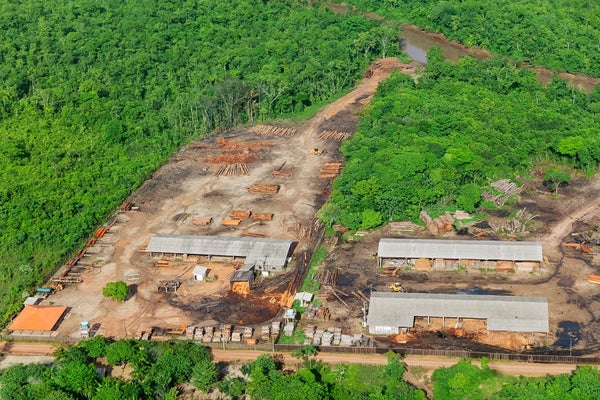

Satellite imagery, like Google Earth, makes it easy for ecologists halfway around the world to check up on tropical forests—see illegal roads and logging, for example. But the info is limited.
"Satellite data often tells you what happens after it's happened." Rhett Butler, the founder of Mongabay.com, an environmental science news website. In a perspective piece in the journal Science, he and his colleagues write that sound recordings can supplement satellite data, as another conservation tool. [Zuzana Burivalova, Edward T. Game, and Rhett A. Butler, The sound of a tropical forest Recording of forest soundscapes can help monitor animal biodiversity for conservation]
"You can actually set up alerts. So you can hear things like chainsaws or gunshots in real time. So you can get out ahead of potential deforestation before it occurs."
On supporting science journalism
If you're enjoying this article, consider supporting our award-winning journalism by subscribing. By purchasing a subscription you are helping to ensure the future of impactful stories about the discoveries and ideas shaping our world today.
Small audio recorders, some of which are solar-powered and hooked to cellphone grids for data upload, also give ecologists the ability to eavesdrop on a jungle's biodiversity over time: "If you're in a primary forest, you'll tend to see all the frequencies of the soundscape occupied by different species.
As a comparison, here's a forest plot after selective logging—meaning some trees were cut, others left standing.
While the human ear is perceptive, algorithms are a much more powerful tool to comb through thousands of hours of data, to get a richer picture of changing tropical biodiversity. "And so that's where you get scalability, if you can create signatures for certain species or animal groups and then run an algorithm that matches those patterns against all the sound data."
Nowadays, many industries—like cattle farming, palm oil, soybean and paper production—are committing to zero deforestation goals, which can be hard to measure. But by coupling satellite data and camera traps with audio recordings, ecologists can keep their eyes—and ears—on what’s going on in the jungle.
—Christopher Intagliata
[The above text is a transcript of this podcast.]

