
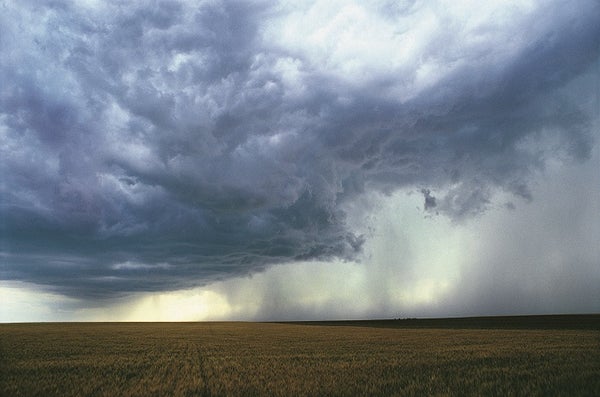

There's nothing like that fresh, rain-washed air after a storm, right? "The idea has always been 'the rain is cleaning.'" Mary Gilles, a chemist at Lawrence Berkeley Lab. She and her colleagues study microscopic airborne particles, so "normally we don't collect during rain. Because our intuition is, 'the air's clean, why would we be collecting right now?'"
Two years ago, they went against that intuition and collected after a rainstorm, at a field in northern Oklahoma. And what they found was actually a wealth of particles—about half a micron in diameter, nearly spherical, and glassy-looking under the microscope. Lab analysis revealed the miniscule bits to be carbon-based blobs of soil material—like decayed bits of plants and soil-dwellers.
But how they got airborne was a mystery. The researchers think that what’s happening, based on a follow-up experiment, goes something like this. The rain leads to puddles. Organic matter leaches into those puddles, forming a film on top of the water. Then, as raindrops strike, they form tiny air bubbles. These bubbles rise to the surface and burst through that layer of organic material, catapulting the soil particles into the air. The study is in the journal Nature Geoscience. [Bingbing Wang et al, Airborne soil organic particles generated by precipitation]
On supporting science journalism
If you're enjoying this article, consider supporting our award-winning journalism by subscribing. By purchasing a subscription you are helping to ensure the future of impactful stories about the discoveries and ideas shaping our world today.
Tiny as they may be, the particles may actually affect the climate. "We think that they have the potential to actually be absorbing incoming solar radiation, and then that feeds back into global climate change." Meaning we might want to factor them into climate models. ‘Cause they appear to be more than just dust in the wind.
—Christopher Intagliata
[The above text is a transcript of this podcast.]
[Scientific American is part of Springer Nature.]
