
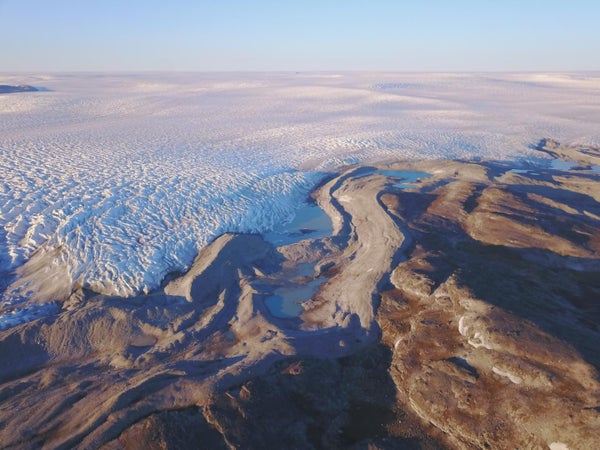

Greenland is the biggest island in the world. And the ice sheet that sits atop it is massive.
“The pile of ice is so thick, it extends more than 10,000 feet above the ocean. And if all that ice were to melt and go into the ocean, global sea levels would rise by 24 feet everywhere around the world.”
Jason Briner, a geologist at the University at Buffalo. The ice sheet is melting, of course. But just how much, compared to the past?
On supporting science journalism
If you're enjoying this article, consider supporting our award-winning journalism by subscribing. By purchasing a subscription you are helping to ensure the future of impactful stories about the discoveries and ideas shaping our world today.
Briner’s team did a computer simulation of the southwest portion of the Greenland ice sheet—which he says is a good proxy for ice melt across the entire ice sheet. The researchers plugged past climate data into that model to “hindcast,” rather than forecast, the past activity of the ice sheet. They then checked the model’s predictions of the past shape and size of the ice sheet by looking at piles of rocks and boulders and dirt on Greenland today, which outline the edges of ancient ice. And the simulation was in good agreement with the actual situation.
Using that reconstruction of the ice sheet over time, the team could compare the ice sheet’s historic losses to those happening today under human-caused global warming. And they determined that Greenland is on track to lose more ice this century than during any century in the past 12,000 years—possibly four times as much.
The results appear in the journal Nature. [Jason P. Briner et al., Rate of mass loss from the Greenland Ice Sheet will exceed Holocene values this century]
Ultimately it’s up to us how much ice actually melts.
“Humanity has the knob—the carbon knob—and that knob is going to influence the rates of ice loss from the Greenland ice sheet.”
If the world goes net carbon zero by 2100, for example, Briner says ice loss could stop entirely at the end of the century, according to one model.
“That was what kept me from being completely depressed about our study.”
Dozens of countries have already announced goals to go net zero by the middle of this century—so far the U.S. is not one of them.
—Christopher Intagliata
[The above text is a transcript of this podcast.]
