

Rachel Feltman: Happy Monday, listeners! For Scientific American’s Science Quickly, I’m Rachel Feltman. You’re listening to our weekly science news roundup.
Let’s kick things off with some tech news. According to a study published last week in Communications Sustainability, artificial intelligence data centers could consume about 1% of all electricity by 2030. Researchers project that demand from the six largest tech operators alone—that’s Microsoft, Google, Meta, Oracle, Amazon and Apple—will jump from 118 terawatt-hours in 2024 to between 239 and 295 by 2030. That increase is about how much energy 27 million American households use in a year. While these six AI power users will account for about two-thirds of the world’s AI energy consumption, the global total for data centers could reach 945 terawatt-hours, or 3% of the world’s global electricity consumption.
What makes the projections more troubling is that more than 90% of the projected global capacity for this computing power is clustered across just three regions. In the US, data centers are expected to cluster in Virginia, Ohio, Oregon, Iowa, Texas, Arizona, and North Carolina. That means that folks in certain areas will bear the environmental burden of the whole country’s generative AI usage. The Environmental and Energy Study Institute estimates that large data centers can consume as much as 5 million gallons of water per day, which is equivalent to the water use of a town with tens of thousands of residents. Data centers also contribute to noise pollution thanks to the use of cooling systems, fans, and backup diesel generators—which of course pollute the air as well.
On supporting science journalism
If you're enjoying this article, consider supporting our award-winning journalism by subscribing. By purchasing a subscription you are helping to ensure the future of impactful stories about the discoveries and ideas shaping our world today.
Our next story comes from SciAm’s Chief Newsletter Editor Andrea Gawrylewski about the hunt for the smallest particles in the universe. Over to you, Andrea!
Andrea: Thanks, Rachel. In 2012 researchers at the Large Hadron Collider in Switzerland announced that they had observed the elusive Higgs boson particle. The Standard Model, which is theorists’ best description of the fundamental building blocks of reality, had predicted the Higgs, and now scientists had spotted it after two years of experiments.
It became the 17th known elementary particle in the universe. All the elementary particles are grouped in two camps: fermions and bosons. Fermions are the building blocks of matter and include particles like quarks, whereas bosons are force-carrying particles like photons. But can these particles be broken down even further?
This turns out to be one of science’s toughest questions. Will we ever find the smallest final building block of nature? If we do discover new fragments of reality, they may reveal that our understanding of elementary physics is flawed. For example, one contending idea is that instead of thinking of particles as points, what if these bits of energy were actually something else, like tiny vibrating strings?
This would mean that a particle's characteristics would then be determined by the string's properties and the way it mingles with other strings, all quivering and coiling near the infinitesimal limits of physical size. To accurately explain known physics, these strings would have to exist across at least 10 dimensions, a geometric structure that is assumed to be accessible only at tiny scales, making this idea difficult, maybe impossible, to test.
Another idea is that spacetime itself may be made of tiny loops. These loops of gravity would be woven together and would mathematically account for the curvature of spacetime. Imagine just like being bathed in light, the grains of quantum spacetime would be all around us. So how can physicists test these ideas?
If strings or quantum loops exist, physicists believe they would be about the size of the Planck length, which is thought to represent a physical limit to how small something can be, about 1.6 × 10⁻³⁵ meter.
To experiment even close to this minute scale, scientists would need a circular particle collider so large that if it was centered on the sun, it would reach a little past the outer orbit of the planet Neptune. That size particle accelerator isn’t happening anytime soon, but scientists are working on upgrades at the Large Hadron Collider that are slated to come online in 2030. They should allow the machine to measure even more particles erupting from collisions. Whether we’ll ever fully understand the underpinnings of existence, however, is anyone’s bet.
Feltman: Thanks for that, Andrea. Listeners, don’t forget to subscribe to Today in Science to get stories like this one sent straight to your inbox.
Now we’ve got a few stories on the miracle of life. This first one is honestly pretty miraculous: scientists have found an organism that thrives at higher temperatures than previously thought possible for this type of life. They described Incendiamoeba cascadensis, whose genus means “fire amoeba,” in a study published last Tuesday in Cell.
What makes the finding particularly cool—or I guess, particularly hot—is that the species in question is a eukaryote. That means that, unlike the organisms that actually hold the top records for withstanding high temperatures, this one has a nucleus. That kind of complex biology requires proteins that scientists generally thought would fall apart at such high temperatures. This little eukaryote was found in samples from Lassen Volcanic National Park in northern California. I guess some amoebas like it hot.
Speaking of life finding a way: For the first time ever, a sea turtle was spotted laying eggs on the west coast of the US. The National Oceanic and Atmospheric Administration Fisheries West Coast posted the news on their Facebook page last week. According to the agency, an olive ridley sea turtle dug a nest near Seal Beach in Orange County, California on September 16. Then, three days later, a turtle—maybe the same individual, maybe not—did the same thing a few miles south.
Olive ridleys tend to hang out in more tropical waters, but they have been spotted in California before. Experts say the turtles are probably following warm currents from this year’s El Niño, perhaps with an additional temperature boost from climate change. The nests in California have been fenced off to protect the eggs during their incubation period, which ranges from 45 to 60 days.
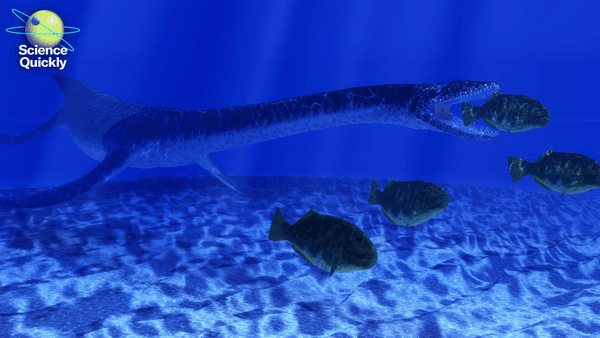
We’ll wrap things up with one last story about the majestic nature of marine life. According to a study published last week in Geological Magazine, plesiosaurs—extinct marine reptiles that lived from around 215 million to 66 million years ago and included the, if you’ll allow me to date myself, Internet-famous genus Liopleurodon—left some very special remains on land: their vomit.
Plesiosaurs had long necks that they likely used to reach shellfish on the seafloor, but it doesn’t seem like they had the tooth power to crush bones and exoskeletons into digestible crumbles. Instead, like owls, it’s thought that they regurgitated compact clumps of mucus-coated detritus.
For the new study, paleontologists had the glamorous task of analyzing more than 20 of these pellets in their fossilized form, which are called regurgitalites. The pellets contained the remains of creatures that need salt water to survive, but they were found in what would have been a river delta with brackish water. That’s why the researchers suspect that plesiosaurs did their hunting in the sea before cruising to shallow waters to rest, digest, and puke. As for how plesiosaurs were identified as the most likely upchuckers, the researchers came to that conclusion based on the composition and size of the pellets, which could be as large as mangos.
Here’s one last fun fact I learned from this study: have you ever wondered how scientists tell the difference between fossilized vomit and fossilized poop? A coprolite, which is the elegant term for a preserved turd, will have a lower ratio of undigested food—along with some distinct mineralogical traces and a more regular shape and scatter pattern. Isn’t science awesome?
That’s all for this week’s news roundup. We’ll be back on Wednesday to talk about how romantic cons are getting harder to spot in the age of AI—and what you can do to protect yourself.
Science Quickly is produced by me, Rachel Feltman, along with Fonda Mwangi, Allison Rodgers and Jeff DelViscio. This episode was edited by Alex Sugiura. Marielle Issa and Aaron Shattuck fact-check our show. Our theme music was composed by Dominic Smith. Subscribe to Scientific American for more up-to-date and in-depth science news.
For Scientific American, this is Rachel Feltman. Have a great week!
