
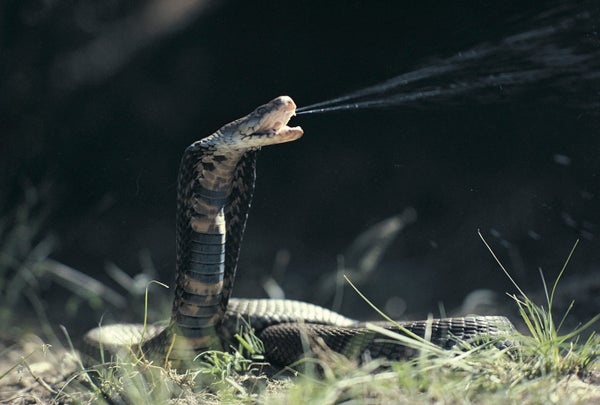

Movies like Raiders of the Lost Ark, Snakes on a Plane and even Harry Potter and the Chamber of Secrets have all relied on the fear of snakes to build suspense and anxiety. About a third of all people are at least a bit phobic about snakes.
Some of the distress when it comes to the slithering serpents comes from their unpredictable movement patterns. But the fear also stems from knowing that, well, snake bites do kill a lot of people—perhaps as many as 94,000 people annually.
But not all snake venom is created equal. Some snakes have venom only strong enough to kill a couple of mice. On the other hand, there’s “the inland taipan in Australia, which is incredibly venomous. It has enough potent venom to kill about 50 adults. Humans.”
On supporting science journalism
If you're enjoying this article, consider supporting our award-winning journalism by subscribing. By purchasing a subscription you are helping to ensure the future of impactful stories about the discoveries and ideas shaping our world today.
Kevin Healy, a lecturer in zoology at the National University of Ireland, Galway.
He wanted to know why snake venom toxicity varied so much, so he and his team looked at 102 different venomous snakes species. They examined how much venom the snakes had as well as what they ate and what kind of habitat they lived in. The key finding:
“Bigger snakes have more venom, in general. But the amount of the increase of that venom increases basically according to how much energy you burn per second, not how big your prey is, as you'd expect.”
The study was in the journal Ecology Letters. [Kevin Healy, Chris Carbone and Andrew L. Jackson, Snake venom potency and yield are associated with prey‐evolution, predator metabolism and habitat structure]
The researchers also found snakes that inhabited three-dimensional environments that include things like trees and water had less venom than snakes that live two-dimensionally—that is, on the ground.
“Our guess is that that comes back to encounter rate. So if you live in a 3D environment, just the pure physics of living in a 3D environment means you will bump into more things. And so what that means is you might not need this really large reservoir of venom to kind of ensure that if you miss a prey item, that you have something for the next time because you're not going to get to encounter individuals that often.”
Whereas the 2D-dwelling snakes need to make sure that when they get a chance for a meal, their venom will pack a punch. Of course, only about a quarter of all snake species have venom at all. Keeping that in mind may make it possible to be braver than Indiana Jones—when it comes to snakes, at least. You should still be very scared to crawl under a moving truck.
—Lucy Huang
(The above text is a transcript of this podcast)

