
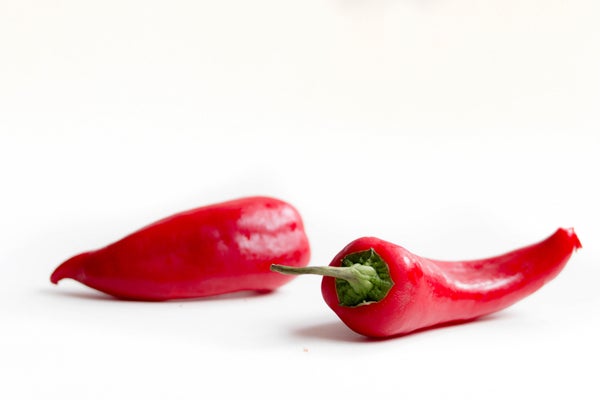

The ingredient that makes hot chilies hot is called capsaicin—and it can set your mouth on fire. But the spicy compound has a soothing effect too: in your gut, it kicks off a chemical cascade that might calm the immune system and reduce inflammation.
Researchers studied that phenomenon in mice. Once inside the gut, the capsaicin molecules plugged into a specific receptor, spurring the release of another compound, called anandamide. Anandamide happens to be an endocannabinoid—similar to active ingredients in marijuana—which binds to cannabinoid receptors in the gut. That last step in the cascade ramped up the production of cells that damp down inflammation in the mice—and even cured them of a mouse model of diabetes type 1, an autoimmune disease.
If all this sounds a bit similar to the chemical messaging that happens in the brain… that's because it is. "The gut has a very large nervous system. It's almost as large as the brain itself. Pramod Srivastava, an immunologist at UConn Health and one of the study’s leaders.
On supporting science journalism
If you're enjoying this article, consider supporting our award-winning journalism by subscribing. By purchasing a subscription you are helping to ensure the future of impactful stories about the discoveries and ideas shaping our world today.
"We don't quite fully understand what this huge amount of neurons are doing in the gut. We don't understand its language, and the molecules and mediators. And I think with this work we can at least claim to have found a couple of words in that language." The study is in the Proceedings of the National Academy of Sciences. [Nandini Acharya et al., Endocannabinoid system acts as a regulator of immune homeostasis in the gut]
So to recap that chemical chain: chilies cause the production of endocannabinoids, which produce immune suppressant cells, which soothe inflammation. So, what if you cut out the chili initiator, and just eat cannabinoids—pot brownies, stuff like that?
"Obviously we are very interested in people who use edible cannabinoids. I'm extremely curious if people with colitis or Crohn's disease, who are edible pot users, do they benefit from it? I have no idea. But it's something we can now find out because sizable numbers of people are consuming those edibles.”
—Christopher Intagliata
[The above text is a transcript of this podcast.]
