
This episode is part of “The Young American Scientists,” an editorially independent project that was produced with financial support from Regeneron.
Rachel Feltman: Happy Monday, listeners! For Scientific American’s Science Quickly, I’m Rachel Feltman.
We’re skipping our usual news roundup today for a special series. This week, we’ll be dedicating all of our shows to SciAm’s inaugural class of Young American Scientists. This group of groundbreaking researchers represent the future of science, technology and medicine. You can find out all about them in the latest print issue of Scientific American, which is coming out tomorrow. And you’ll also hear from a few of them this week on Science Quickly.
On supporting science journalism
If you're enjoying this article, consider supporting our award-winning journalism by subscribing. By purchasing a subscription you are helping to ensure the future of impactful stories about the discoveries and ideas shaping our world today.
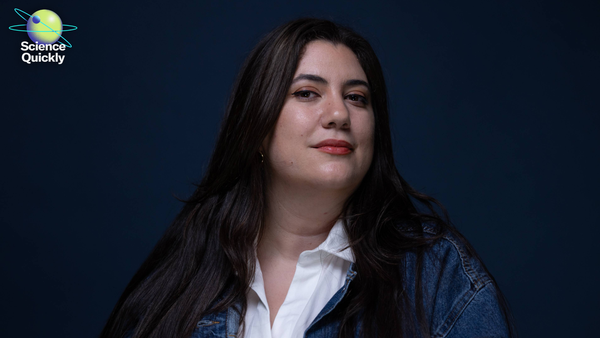
Today’s guest is Erini Lambrides, a postdoctoral fellow at NASA’s Goddard Space Flight Center who’s also affiliated with the University of Maryland, College Park. She’s here to tell us about her unusual path from aspiring actress to astrophysicist.
Feltman: Thank you so much for coming on to chat with us today.
Erini Lambrides: Thank you so much for having me.
Feltman: So you didn’t always know that you wanted to be an astrophysicist. What first attracted you to the field?
Erini Lambrides: So I initially thought I was gonna be an actress. And I’m from New York City, born and raised in Brooklyn, and in New York, you can be in specialized schools for really whatever you want.
And so at high school, I went to LaGuardia school for the performing arts [Fiorello H. LaGuardia High School of Music & Art and Performing Arts]. I was in acting. And when you’re in an art school in New York City, that normal teenage urge to be different from everyone else looks a little different because everyone’s artsy, everyone’s cool and figuring out their identity.
And I’ll never forget, I went to the library at school, and I was walking around, and I saw this book that caught my eye, and this is so corny, but it was like, A Brief History of Time, and as a joke, I picked it up. And I started flipping through it, started reading it on the train during my commute to school, and it rocked my world.
I was just, until that point, felt very disconnected from nature. I had a very kind of black-and-white view. I was like, “Oh, you know, I’m an artist.” And it also was very satisfying to be in a place where I was the only one who wanted to ... be an astrophysicist, and I didn’t even know what that meant. The first time I heard the word astrophysics was, I’m not joking, in Top Gun, because for some reason, the love lead of Tom Cruise was an astrophysicist. And at that point, I heard of physics, and then I heard astrophysics, I’m like, “Oh, that sounds like space. Physics, space, that sounds great.”
So I was telling everyone that’s what I was gonna do. And I applied to one college, this was the University of Rochester—it was pretty random—went in and majored in physics without ever taking a physics class before, or calculus. So it was sheer will. And I was really fortunate when I actually started doing the thing I kept telling everyone I was gonna do, that I really liked it. And especially when I started doing research, absolutely fell in love, and I can’t imagine doing anything else.
Feltman: Wow, that’s such a great story, I think especially because we don’t think of astrophysics as being something that people stumble into. So I would love to hear, like, what was it about the vibe of astrophysics that first attracted you and then what was the actual experience like, and what kept you going?
Lambrides: So some of the first concepts that, like, really blew my mind was the bigness of it all. And I think the reason why I was drawn to specifically astrophysics is the scales of which the universe is comprised of is so beyond the normal realm of our experience as humans in our day-to-day, that it’s an act of will of your own mind to just try to relate to how big everything actually is.
So you know, humans [are] notoriously, famously bad at understanding the difference between a million and a billion, intuitively. And now, in astrophysics land, you’re regularly jumping back and forth between scales, and I think that really something so much bigger than myself and everything that I ever knew was one of the draws to it.
I think I also was blown away by how much we’re still actually figuring out. There’s a part of me that thinks it would be kinda lame if humans were right about how we think the universe works right now, because it makes the universe feel a lot smaller, that us puny humans can understand it—which is, I know, a hot take as a scientist who’s publishing things and giving people my opinions on what I think is going on in the universe.
But, you know, that openness, the discovery, the trying to figure it out, putting the pieces of the puzzle together to understand why the world around us looks the way it does, from the first concepts I learned in these pop sci books, just threw me into it.
So when I started actually as a physics major, you’re not doing fun stuff. Like, you’re calculating, you know, [the] speed of a ball rolling down a hill. You’re not looking at the glories of the splendor of the universe. And it was hard. I actually did horrific in my first class ever in physics. It was an honors majors physics course. I did not realize this. I thought everyone was a genius in my class. Little did I know, every single person had already taken physics before. They’d taken AP Physics, you know, the first one and the second one. They had tutors. The reason why they were a physics major is because they took physics and liked it and saw they were good at it, versus me, who, like, read a couple of pop sci books and saw Top Gun and, you know, was just a girl from Brooklyn with a dream.
Why this one? Unclear, you know. I also liked that it was so, like, not on brand for me, and I think, like, there was this act of rebellion almost going into nerddom. Um, but that’s when I discovered sci-fi—around the same time. I discovered Star Trek. I discovered science-fiction books like, you know, Ursula K. Le Guin, Octavia Butler, and just my whole life shifted. And so despite getting a C– in this first physics class, I didn’t drop the major.
And what was crazy is: So your first two years in a physics major, you’re pretty much—for most people, it’s a lot of review. They’ve already seen a lot of this material before. For me: all brand new. This is the first time I’m seeing any of these things, and so I am, like, drowning. But I learned how to swim. And by the time we get to the more advanced-level courses in your third and fourth year, I’ve built the muscle of knowing what to do when you see something that’s completely out of depth of anything that you’ve done before, there’s no relation to it. And a lot of my classmates, for a lot of them, that was, like, the first time that they were really encountering that in a long time. So I started doing really well, and it was around the same time as me getting into research, which initially was physics research. It wasn’t even space research. It was inertial confinement fusion. And I just started getting better and better.
And it’s just been this really funny way of getting to where I am now at NASA and specializing on really big black holes and trying to understand how they got so big and what their point is in the universe to, you know, a kid from New York who was in art school and wanted to stand out from her peers. [Laughs.]
Feltman: It’s really cool to hear you talk about this because, you know, there’s so much research on the different points in the pipeline where people tend to fall out of science and math majors. And I know me, personally, I’m very happy to be in the career I am in now and I do technically have a science degree but I thought I was going to be in research for the long haul. And I, I remember that first time I got a C in a college class, I was like, “Oh, that means I’m not very good at this. Time to find a new focus.” And it’s a shame that that happens. So I’m really curious about, you know, how your experience informs some of the work that you do as a mentor.
Lambrides: Yes. Because in the end, it is made up who’s good, who’s gonna be good, who has the potential to be good. It’s all couched in opinions that are colored from your own experiences on how you think the world works, and that means whatever systems you are a part of and have not dismantled, that’s how you’re going to see it. So when you’re seeing someone coming into a program and they, like, get a C, it’s actually not very informative on whether they’re going to be a great researcher or not.
You know what is? They obviously love it enough to keep trying and doing it again. Choosing, despite not doing well but wanting to do better—in my opinion and what I see in terms of the students I mentor and, you know, students that I have—on, you know, how successful are they going to be.
The good thing about acting and going through that is: You get taught rejection. It’s the name of the game. It’s mostly no’s. But the way rejection gets taught to you is a little different. When you don’t get an audition, or you don’t get a part you wanted, it’s less of a failure and more, “Well, like, obviously they’re looking for something really specific, and I just wasn’t that mark.” When you now transition to the yes’s and no’s and the gatekeeping of that is academia, which is basically a series of yes’s or no’s: Will I get into graduate school? Yes or no. Will I get this fellowship? Yes, no. Will I get this research grant? Yes, no—I’ve kind of went into it already coming with this callus of rejections from acting. That does not mean things don’t hurt, but it definitely did prepare me for that.
And it is very satisfying to eventually start doing really well and knowing that, yeah, I got a C– in my first class, and, you know, just kinda like a, uh, out of spite almost, just like, ’cause I could, you know?
And I use this to inform how I train, how I teach, how I mentor—you know, “What are the benefits of the doubt people are giving? Who do we give benefits of the doubt to? Do they look a certain way? Do they come from a certain background?”—and really challenging those.
Feltman: That’s awesome. Well, let’s talk about your research. So what’s interesting about young black holes?
Lambrides: Yeah. So, like, the TL;DR [too long; didn’t read] is: In almost every single galaxy we’ve ever looked at, there is a massive black hole in the very center of it. Even though you think supermassive black hole, you think, “Wow, that must be really big,” but it’s actually kinda small when you compare it to the scale of the galaxy that it lives in. And this is really consequential because for, you know, the past 60 years, we’ve observed galaxies and their supermassive black holes in the center, and we see these relationships that pop up, relationships that make it seem like the growth of the galaxy and the growth of the black hole is connected despite the fact they’re on really different scales.
Like in our Milky Way, we have Sagittarius A*, which is our central supermassive black hole. If we were to take Sag A*, pluck it out of our galaxy, absolutely nothing would change in [your or my life]. It is kind of inconsequential in terms of dynamics. Like, you know, the gravity from this supermassive black hole is really out of our reach.
So it’s a big question: Why and how is the growth and life of one of these objects, galaxies, related to the growth of the black holes in the center? So naturally you wanna ask yourself, “Okay, well, how did it first start?”
So naturally, this question of, “What did the first massive black holes look like, and what do their galaxies look like? What are the initial conditions of the relationship? How did they form? Are they doing anything to, you know, the properties of these first galaxies?” was an open one. And so a lot of my research is basically trying to put the pieces of that puzzle together and to use data across the entirety of the electromagnetic spectrum, so all of NASA’s flagship telescopes and then some, to look at really early massive black holes in their galaxies and try to say something.
And during this past couple years, I was one of the early people that stumbled into little red dots, which are—funnily and very typical of astronomers—[a] name that, you know, the public hears, and they’re like, “What are these astronomers doing? What are these little red dots?” But for once, it’s kind of aptly named, because they do look like little red dots. And these are these set of sources we found with JWST [the James Webb Space Telescope], NASA’s newest flagship telescope, which, at first, when people were looking at them, they thought they were galaxies, and they were like, “Oh my God, we’re breaking the universe. Look at all these galaxies in the beginning of time that are so, you know, seemingly old.” And then we’re like, “Oh, maybe they’re being powered by growing supermassive black holes.” And a lot of my research as of late has been trying to really understand them. How similar are they to the other growing supermassive black holes we know of? How are they different? How do we square them away with each other into some coherent picture?
And the reason why this is important for you, listener, who’s going about your day, is: Everything that happened to get to you, where you are on Earth right now, is a series of relationships happening with the astrophysical phenomenon. One of the biggest ones is the relationship between the black hole in the center of our galaxy and the galaxy around it in terms of the metals that are going into the stars that go nova that then give the iron and things on Earth, which we call enrichment, the amount of star formation that’s happening in a galaxy.
All of these things will impact how Earth, and ultimately you, came to be. It’s these big movers and shakers on really grand scales. And so the types of things I work on is trying to understand these scales and these really, you know, crazy astrophysical phenomena, like creating and growing supermassive black holes, and squaring this away with this new discovery of little red dots, which make it seem like there was a lot more of them in the early universe than we thought.
Feltman: So as we’ve established you came to astrophysics in a pretty unique way. But what would you say is unique about the perspective you bring and maybe your research methods?
Lambrides: So I kind of buck at authority in the terms of, like, you know, just because someone says something doesn’t mean I’m gonna, like, take it at face value. And it’s a really interesting place to be with that, especially with little red dots, because there’s a lot of confidence about what they are and what they aren’t.
And frankly, I would argue we are still in the early days of their understanding. And so a lot of my research is coming from the perspective of—not that, like, I’m this lone wolf genius, but rather never taking anything for granted and not assuming something to be true just because someone else said it was true, which is a thing that many scientists do, but it gets really hard when people are moving really fast on things, to not just fall into a camp very easily.
Secondly, one of my favorite things to do is to try to learn from a completely unrelated subfield or modality and seeing how we can apply that to gain new perspectives or insights on some of these problems we’re spinning our wheels on.
And so a lot of my work has kind of this theme of, you know—okay, well, there is this, like, paper from like the 1980s or the 1990s that, like, did this in this context. It was kind of forgotten about. Actually, we can learn from that, and if we apply it to this brand-new problem with brand-new data, we actually get a different story or a different answer.
And so I think a lot of that comes from the fact that I switched from, like, acting to physics and finding that there was commonality between the two. I mean I went through some of that acting training to be able to just be on this call with you, communicate science, trying to figure out ways to, you know, distill really complex topics with all this jargon into ways where you don’t have to have gotten a Ph.D. to understand the gist of what I’m saying.
It’s definitely bled into my science and how I do science, because, third, I fully believe it takes a village, in all aspects of life and especially in science. The thing that keeps me in this field, despite the difficulties, the competition, the lack of funding, you know, being in one of the worst job markets since, like, 2008, is the people. Collaboration, you know, it’s what’s gotten me through any of the hard times, both scientifically and as a person. So I very much subscribe to the view that science is not this immutable, objective concept. Objectivity is impossible. We are humans, not machines. We can strive for objectivity, but every decision we make, in terms of how we set up our experiments, in terms of, you know, the opinions that we have about, you know, interpretations of our results, it’s all coming through the very same brain that makes us humans, which means you cannot take humans out of science.
And so it’s been very important for me to develop and build and be a part of communities. It makes, one, my science better, and the type of science projects my research likes to do is trying to find ways to connect people from really different realms.
There’s that, and then also having your village and your community to go through the process of being a scientist. It is hard right now. And so having support and having community is really important. So anything that is assuming that great science is happening in isolation—I will die on a hill about this—I think that’s actually impossible.
Feltman: I’d love to hear your advice for early-career scientists, or even just young people who are interested in science who, you know, maybe hear that message and think it’s awesome but don’t really know where to start. What’s your advice on what they can do to kind of swim against the current in terms of just how academia is really structured to kind of silo people?
Lambrides: Finding your people. So I founded this program called NASA-PEER, which is at NASA Goddard, and it was one of the ways that I found community going at NASA, was finding other like-minded individuals in my career stage who cared about mentoring and, you know, connecting early career researchers to science and apply to grad school, all that stuff.
A big tenet that we do at NASA-PEER is building your mentorship network. And so this is—there should never be just one person where you’re getting all your thoughts and opinions on what you should do and how you should do it from. Cultivating a network of mentors is really helpful—and having different mentors be used for different things.
Some mentors can be best talking about the identity, you know, [they] may have similar identities and navigating through academia with those identities. Some are in the same exact, you know, science discipline you might wanna get into. Some have the type of career that you want.
And honestly, what is determining whether most people, at least in my field of astrophysics, are making it to point A to B is “How good was their mentorship and how early on?”
And then, two, you know, the love has to be there. A big thing that happens is when you do something or try to do something for a long enough period of time, it becomes a part of your identity. And then it becomes really difficult to be able to tell, “Am I doing this because I like the identity of the X thing or because this is my passion?” And that is, like, one of the most difficult things, especially in stuff like academia and physics and astronomy, where, when you say it out loud, sometimes it feels like there’s a social clout that comes with it, like a “Oh, wow, you must be so smart.” I think it’s really hard to do this if you don’t have some sort of deep passion or love for the question that you’re asking scientifically.
You know, there’s a reason why my parents were very confused. They were like, “You’re gonna go from the arts, famously competitive to get a job in, to, you know, the type of academia spaces that I occupy, which are also very competitive and hard to get a job in? That doesn’t mean it shouldn’t be done or that you shouldn't have passion or fight for your dreams. But it means you need to be strategic in how you fight for your dreams.”
Feltman: That’s all for today’s episode. We’ll be back on Wednesday with another Young American Scientist honoree to talk about the surprising neuroscience behind learning new things.
Science Quickly is produced by me, Rachel Feltman, along with Fonda Mwangi, Sushmita Pathak and Jeff DelViscio. This episode was edited by Alex Sugiura. Marielle Issa and Aaron Shattuck fact-check our show. Our theme music was composed by Dominic Smith. Subscribe to Scientific American for more up-to-date and in-depth science news.
For Scientific American, this is Rachel Feltman. Have a great week!
