
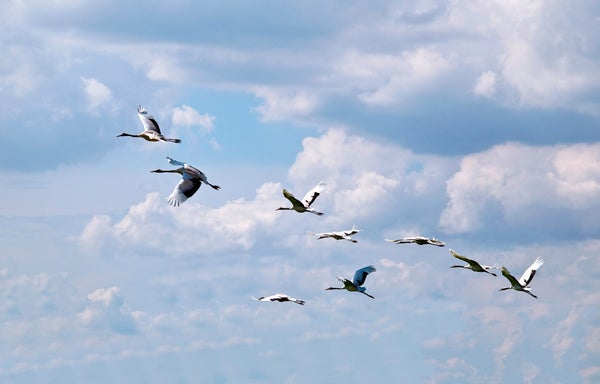

You may have spotted V-shaped squadrons of geese heading south this fall. But for many migrants—like smaller songbirds—nighttime is the right time, when it comes to migration. Winds are gentler. And darkness helps them avoid airborne attacks. Of course darkness also makes it harder for us to see them. Which is where weather radar comes in.
"These radars were designed to detect water drops in the air, precipitation in the air." Jeff Buler, an ornithologist and aeroecologist at the University of Delaware. "They also detect any other large object that will reflect back radio energy. It essentially sees insects and bats and birds as large drops of water."
Buler and his team used three weather surveillance radars to track migratory birds near the Great Lakes—observing four spring migrations in a row. And what they found was, as the night migration ended, and dawn broke, many birds in flight over the lakes turned back. Decided to quit for the day. Which meant crowded real estate on the south shore of the lakes, as the birds piled up there to wait out the day. The study is in the journal The Auk. [Kevin M. Archibald et al., Migrating birds reorient toward land at dawn over the Great Lakes, USA]
On supporting science journalism
If you're enjoying this article, consider supporting our award-winning journalism by subscribing. By purchasing a subscription you are helping to ensure the future of impactful stories about the discoveries and ideas shaping our world today.
The message for conservators? "Restoring one hectare of forest along the shoreline of Lake Michigan might be able to support more migrants than a hectare of forest 50 km away from the shoreline." Because birds—just like humans—like that lakefront property.
—Christopher Intagliata
[The above text is a transcript of this podcast.]
