
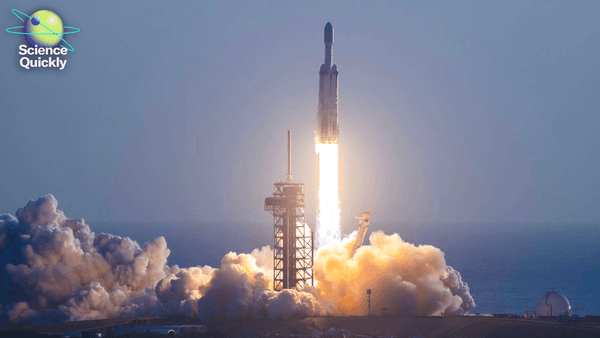

Rachel Feltman: Happy Monday, listeners! For Scientific American’s Science Quickly, I’m Rachel Feltman. We’re kicking this week off by focusing on one major science news story: the launch of NASA’s next great space observatory.
Early in the morning on Sunday, August 30, the Nancy Grace Roman Space Telescope launched from NASA’s Kennedy Space Center in Florida on a SpaceX Falcon Heavy rocket. It’s now on a month-long journey to a spot known as Lagrange Point 2, or L2, which is more than 900,000 miles away from Earth.
Our guest today is Julie McEnery, who serves as senior project scientist for the mission. She’s here to tell us why scientists are so excited about this new space telescope and what it could teach us about the universe.
On supporting science journalism
If you're enjoying this article, consider supporting our award-winning journalism by subscribing. By purchasing a subscription you are helping to ensure the future of impactful stories about the discoveries and ideas shaping our world today.
Thank you so much for coming on to chat with us today.
Julie McEnery: It’s a pleasure to be here.
Feltman: So how long has this telescope been in the works?
McEnery: If you start the clock when scientists first started imagining “What kind of mission would you want to put together to explore the newly discovered accelerating universe?” it starts in the early 2000s.
Feltman: Well, and so let’s take a step back for our listeners to talk about that. You know, what discoveries led scientists to want an observatory with these capabilities? You know, what questions were they starting to get excited to answer?
McEnery: Well, there’s three separate questions. So one of the most prominent was the discovery that our universe is accelerating. The idea that our universe is accelerating is crazy, right? What you know about in the universe is that the universe has matter, and gravity acts on matter, and it pulls it together. We would expect our universe to continue expanding at a constant rate or to even start to contract. When we went to measure how the universe is expanding as a function of time, we discovered that it’s actually accelerating, and that’s as crazy as if you were to throw a ball in the air, and instead of the ball coming back down, it accelerates out of there. So one of the reasons for Roman was to build an observatory that was going to be able to measure that phenomenon much, much better.
At the same time, the study of exoplanets, planets around other stars, was exploding. And one of the things that scientists wanted to do was to be able to design an observatory that could find a large number of exoplanets that were at large distances from their host stars using a technique called microlensing. And that technique requires a mission with a wide field of view and a good sensitivity.
And then there were also a group of scientists who were really interested in the science that you could do if you had wide-field, near-infrared surveys. And it turns out that a mission that gives you exquisite performance, exquisite sensitivity and an ability to conduct wide-field surveys in the near-infrared could address all three of those science questions, and that’s how Roman was born.
Feltman: Wow. So to accomplish all of these things with an observatory, what does its instrumentation need to be capable of? You know, what kind of technological hurdles did NASA face with this mission?
McEnery: So we needed a couple of things. We needed to have an optical design of the telescope itself, the optics in the telescope, that would allow you to have a large field of view with good optical performance.
That’s reasonably well understood. It’s a matter of, uh, building it. We needed to build a large camera that had the ability to have very fine pixels, that was exquisitely sensitive. We want to be able to—say, if you imagine looking at a star and measuring how bright it appears, that the next time you go back, you’re measuring exactly the same brightness, that your instrument itself is staying perfectly stable. So we wanted to design the camera for our telescope that had very fine pixels, that was very sensitive and was very stable. And we did that by working with Teledyne to design a new generation of improved detectors and by in-house developing new readout chips that could control those detectors, in a very stable, low-noise way.
And then the final thing that we needed to do is we needed the observatory itself to be extraordinarily stable. Roman is the most stable telescope that NASA has ever built. The telescope itself is, is really beautiful. It’s built to extraordinarily high precision. The rest of the observatory, every single aspect of the design has considered stability. So we have thought about: Well, if you move the high-gain antenna, what’s gonna happen? The stability of the observatory. If we slew from one place to another, what’s gonna happen? The stability of the observatory. If we slew from one place to another with the sun in a particular direction, we understand what’s going to happen, and that has informed all of our design choices so that we’ve ended up with a really beautiful observatory.
Feltman: I would love to talk about where the observatory is headed in space. I love talking about L2, so I would love to hear your explanation for why it’s going to be where it’s going to be.
McEnery: So the Roman is gonna travel a million miles from Earth to the sun-Earth Lagrange point. We will be in an orbit around that quasi-stable point, and it’s a really great place to be. We’re far enough away from the Earth and the moon that we don’t look directly at them, but they don’t block a large part of our vision. The sun is always in the same place on the observatory. We’re not going through night and day as you would if you were in a low-Earth orbit, and that allows us to keep the observatory very thermally stable. So it’s a great place to be.
Feltman: Now, I hope you’ll forgive such a basic question, but I know that a lot of our listeners have heard about very exciting space telescopes in recent years and might be wondering, “Why so many? How is this one different from James Webb?” So could you tell us about why this observatory is unique, both in terms of its design and the kind of scientific questions it’s going to answer?
McEnery: So one way to compare the James Webb Space Telescope and Roman is the James Webb Space Telescope is like a telephoto lens that is really good at seeing things very far away, and Roman is like having a wide-angle lens where we get to see a lot at once. And they are both really good at the things that they are designed for. Roman doesn’t just have a large field of view. The observatory itself is also designed to move and stop on a dime and be ready to take the next image. So we can do bap, bap, bap, bap, bap to map out large regions of the sky very, very quickly and efficiently, and that gives us extraordinary capability.
We survey the sky a thousand times faster than Hubble. So to just give you an example of what that means we can do a survey, we can take one month of observations and do a survey of our own Milky Way galaxy, and that survey will find something like 20 billion stars. That will make it the largest catalog of astronomical objects we’ve ever produced with just one month of Roman observations.
That isn’t even our main survey. Our main survey will take a year and will be extraordinarily huge. It took me a little time to sort of think about how to convey just how amazing that survey is. If you were to take one Roman field of view, and you wanted to fully display it on a set of 4K TVs, you would have to have 36 4K TVs.
If you wanted to take our main survey, the one that’s gonna take a year, and display it on 4K TVs, you would need more than half a million 4K TVS. Half a million 4K TVs, you know, you could sort of think, well, you know, I don’t know about you, but it’s not obvious to me how many 4K TVs is half a million 4K TVs.
Feltman: Yeah. [Laughs.]
McEnery: But, you know, it’s the equivalent of covering—not Mount Rushmore, Mount Rushmore is too small—but fully covering El Capitan in 4K TVs, or fully covering 45 Manhattan city blocks. And that just gives you a sense of just how extraordinary the Roman surveys are. This is something that neither Hubble nor Webb can do. So Hubble and Webb will, will continue to do the fantastic things that they do, and Roman will do these completely groundbreaking surveys.
Feltman: Wow. Are there any questions that you are particularly excited for Roman to help us answer?
McEnery: If you’re asking me what my favorite science question is, you’re kind of, like, asking me to, like, choose my favorite child. I kind of love it all. What I think I’m most excited about, though, is the prospect of discovery.
We’re going to be mapping out large regions of the sky without having anything in particular that we’re trying to find there. So we’re gonna find all the things that we knew were there, but we’re also gonna find all the things that we didn’t know to look for. And we’re going to do that both in space by covering a large part of the sky, but also in time by going back to the same part of the sky over and over again.
So we will see new things that go bump in the night. We’ll see new extraordinary things in the sky from our surveys. So I’m excited to find out what I didn’t know.
Feltman: Yeah. Well, so we’re recording this a few days before the anticipated launch, expecting that everything will go according to plan. NASA is very good at getting things up into space. But what are some of the risks and concerns that remain at this stage, both, you know, during the launch and during the telescope’s journey to its destination?
McEnery: So what are our concerns? We don’t have large concerns. We have a really good team of people, and we’ve sat and thought really deeply about what could possibly go wrong. And as we identify those things, we take actions to protect ourselves against that. But you can always be surprised.
This mission is ahead of schedule, and it’s under budget, not because we didn’t have problems, but because the team has been good at solving them. So it is possible that, maybe a detector isn’t configured quite right. Maybe it’s a little bit hard to calibrate something. But if our performance on the ground is anything to go by, the team will be able to solve whatever it is that we find and leave us as good or better to do the great science that Roman is going to do.
There’s another reason, that it might take us a little while to get fully started on Roman science, and that’s that our data volume is huge. We have collected just in our test campaigns more data than Hubble and Webb combined have collected. So this is gonna force users of Roman to think differently about how they approach the data. You can’t download 20 petabytes of data to your laptop. I think there’s going to be a little bit of a learning curve where people in the community get used to the idea that there’s a new way to use Roman data, and that’s to access Roman data in the cloud where we’ve hosted it, that we have compute that people can use. It’s a Roman environment. It’s easy to explore, and find new exciting things in the data. And we make Roman observations available as soon as they’re processed. So a high school class in Kentucky can access new Roman data, find new Roman discoveries, at the same time as a professor in Princeton.
I would like your listeners to know that Roman is going to conduct an extraordinarily capable, revolutionary surveys that will have the ability to transform and impact every area of astronomy. The data are immediately publicly available. We want as many people as possible to get involved. We want to lower the barriers for people to get engaged, because ultimately, the amount of science that we get from Roman isn’t going to be limited by our data. It isn’t going to be limited by our observations. It’s going to be limited by how many people we can encourage to get involved and to try and find the exciting new things that are going to be in our observations. So consider this an invitation.
Feltman: Thank you so much for that invitation and for coming on to talk with us today.
McEnery: Great.
Feltman: That’s all for today’s episode. We’ll be back on Wednesday to learn how volunteer hackers are helping protect your access to water.
Science Quickly is produced by me, Rachel Feltman, along with Fonda Mwangi and Jeff DelViscio. This episode was edited by Alex Sugiura. Marielle Issa and Aaron Shattuck fact-check our show. Our theme music was composed by Dominic Smith. Subscribe to Scientific American for more up-to-date and in-depth science news.
For Scientific American, this is Rachel Feltman. Have a great week!
