
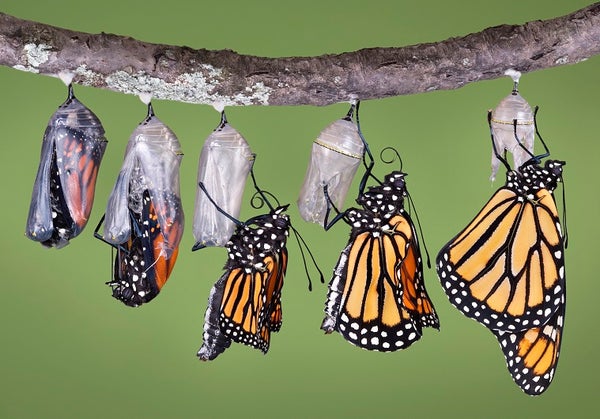

Monarch butterflies depend on milkweed. They lay their eggs on milkweed, and their caterpillars eat only the leaves of the plant. No milkweed means no monarchs. So the best way to help declining monarch populations—and to preserve their epic, multi-generational migration—is to plant milkweed.
Seems simple, right? But the reality is far more complicated.
Milkweed is slightly toxic—the plant evolved its noxious substances to keep herbivores from chowing down on the leaves. But monarch butterflies evolved tolerance. In fact, they arm themselves with the stuff.
On supporting science journalism
If you're enjoying this article, consider supporting our award-winning journalism by subscribing. By purchasing a subscription you are helping to ensure the future of impactful stories about the discoveries and ideas shaping our world today.
"Monarchs sequester these toxins as an anti-predator defense and anti-parasite defense."
Louisiana State University biologist Matt Faldyn.
So, by ingesting the toxin, the caterpillars become toxic themselves. That keeps them safe—as long as they don't ingest too much of the poison. The problem is there are different types of milkweed. And one that’s native to the tropics is now growing in the southern U.S. As these plants sense warming temperatures, they produce more of the toxin—so much more that the monarch butterflies begin to suffer.
To gauge the threat, Faldyn and his team raised monarchs on either the non-native tropical milkweed or on a native milkweed. And they also tested the effects of current environmental conditions as well as temperatures expected for the southern U.S. by the year 2080.
Monarchs that ate native milkweed had comparable survival rates at both current and higher temperatures. But under those future warmer conditions, monarchs raised on the tropical milkweed survived at only one fifth the rate of butterflies raised under current conditions.
The monarchs could thus find themselves in what's known as an ecological trap. The butterflies seek out milkweed, but what is already the most common type of milkweed in the southern U.S. will eventually kill them.
The tropical species is prettier than the native ones, which is why many people prefer to plant it. But there’s still time to change that.
"What we show is that maybe there should be more of a focus on having native species to your area preferentially planted in your gardens."
By switching to the native species, home gardeners across the country can each do their part to ensure that monarch butterflies will avoid fluttering their way into the ecological trap—which could be fatal.
—Jason G. Goldman
[The above text is a transcript of this podcast.]
[Matthew J. Faldyn et al., Climate change and invasive, tropical milkweed: an ecological trap for monarch butterflies.]
