
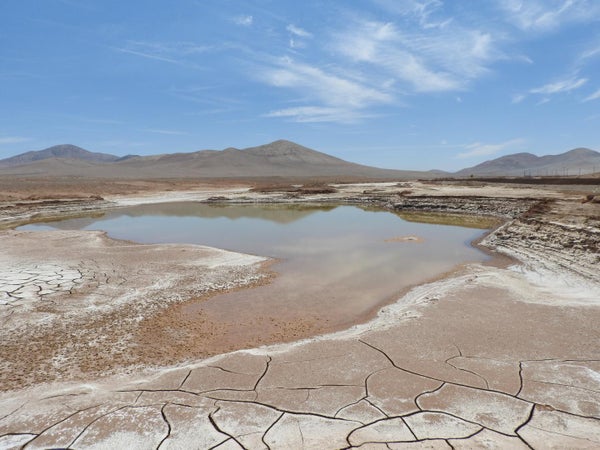

The Atacama desert in Chile is one of the driest spots on Earth. Sometimes, you can't see any life at all.
"As I was a kid those drives were very boring…because there was nothing to see."
Armando Azua-Bustos was born and raised in Atacama. He’s now an astrobiologist at the Spanish National Research Council's (CSIC) Center for Astrobiology.
On supporting science journalism
If you're enjoying this article, consider supporting our award-winning journalism by subscribing. By purchasing a subscription you are helping to ensure the future of impactful stories about the discoveries and ideas shaping our world today.
But he says, with closer inspection, life can be found. "There is life around, but you have to take a microscope to see microorganisms in those driest places in the Atacama."
Then in 2015, and again in 2017, freak storms from the Pacific flooded the Atacama. Ten times the usual amount of rain fell, turning some of the driest parts of the desert into lagoons.
But the desert's hardy microbial life didn't exactly burst into bloom. "I start looking at the microscope and I couldn't see anything! That was surprising. I was expecting to see a zoo of little things moving all around. But I couldn't see anything."
In fact, after sampling three of the newly submerged areas, his team found only a quarter of the microscopic species they'd previously isolated in the desert region—perhaps, he says, because the water killed the rest, through a process called "osmotic shock." "The cell doesn't have the mechanisms to get all the water that is going into the cell to get it out, so they start inflating like a small balloon until they burst out."
The results are in the journal Scientific Reports. [A. Azua-Bustos et al., Unprecedented rains decimate surface microbial communities in the hyperarid core of the Atacama Desert]
The microbial massacre should serve as a cautionary tale, he says, as we search for similar dry-adapted lifeforms on Mars. Because several of the life-detecting experiments performed by the Viking landers involved—you guessed it—adding water. And it would be tragic if we killed the first extraterrestrial life we found.
—Christopher Intagliata
[The above text is a transcript of this podcast.]
