
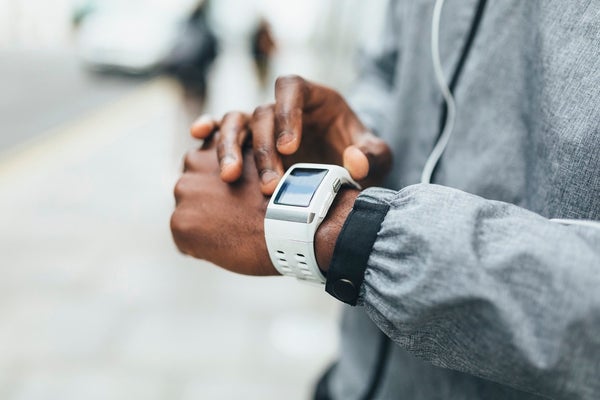

One of the biggest drawbacks to wearing a smartwatch is how often you have to take it off to charge it. But here's an idea. How about charging it with a power source that's pretty ubiquitous nowadays: wifi?
"Wifi signals are all around us and most of them are just wasted." Xu Zhang, an electrical engineer at MIT. Writing in the journal Nature, he and his colleagues describe a device, called a "rectenna", designed to capture energy from wifi signals—and turn it into direct current electricity. [Xu Zhang et al., Two-dimensional MoS2-enabled flexible rectenna for Wi-Fi-band wireless energy harvesting]
The rectenna consists of a small gold antenna—about the size of an SD card—which converts a variety of wireless signals—wi-fi, bluetooth, cellular LTE—into an AC signal. Next, a three-atom-thick layer of molybdenum disulfide converts that AC signal into usable DC electricity. That layer is called a rectifier. Slap it onto the antenna, and the result is the "rectenna."
On supporting science journalism
If you're enjoying this article, consider supporting our award-winning journalism by subscribing. By purchasing a subscription you are helping to ensure the future of impactful stories about the discoveries and ideas shaping our world today.
The device is flexible and, using typical home wi-fi signals, it spits out about 40 microwatts. Enough to light up a simple LED display or power a biosensor. It's not enough juice for power-hungry smartwatches and smartphones just yet. But Zhang says their next goal is to build an array of rectennas to power larger devices.
The scientists also envision a smart city where buildings, bridges and highways are studded with tiny sensors to monitor their structural health, each sensor with its own rectenna, so it never goes dark. "We can in some sense bring intelligence to almost every object around us, and that can enable ubiquitous sensing."
Because a "smart city" becomes a lot less intelligent when it runs out of juice.
—Christopher Intagliata
[The above text is a transcript of this podcast.]

