

Hi, I’m Scott Hershberger, with Scientific American as an American Association for the Advancement of Science Mass Media Science and Engineering Fellow. And here’s a short piece from the September 2020 issue of the magazine, in the section called Advances: Dispatches from the Frontiers of Science, Technology and Medicine. The article is titled “Quick Hits,” and it’s a rundown of some stories from around the globe.
From Argentina:
The earliest dinosaurs laid soft-shelled eggs, paleontologists say. A new chemical analysis of a more than 200-million-year-old fossilized egg from Patagonia—and a clutch of more recent eggs from Mongolia, found in the Gobi Desert—revealed a thin film matching the characteristics of modern soft-shelled eggs.
From England:
Archaeologists found that 20 deep shafts, previously thought to be natural sinkholes and ponds, were dug by Neolithic humans. The shafts form a circle two kilometers in diameter, with the Durrington Walls monument at its center, just three kilometers from Stonehenge.
On supporting science journalism
If you're enjoying this article, consider supporting our award-winning journalism by subscribing. By purchasing a subscription you are helping to ensure the future of impactful stories about the discoveries and ideas shaping our world today.
From Brazil:
Researchers documented the largest lightning bolt ever recorded. The “mega-flash,” which extended for more than 700 kilometers in southern Brazil in 2018, was detected by a new advanced weather satellite in geostationary orbit.
From Israel:
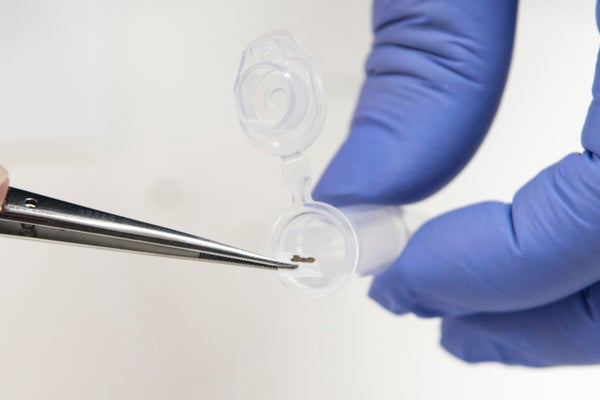
Researchers sequenced DNA samples from the Dead Sea Scrolls, identifying fragments made from sheep skin and others made from cow hide. The technique could help match fragments together and unravel the artifacts’ geographic origins.
From Indonesia:
Scientists identified an elusive nose-horned dragon lizard in the forests of North Sumatra. Despite appearing in the mythology of the indigenous Bataks, the visually striking species had been spotted by scientists only once before—almost 130 years ago.
And from Australia:
Submarine drones uncovered an extensive system of underwater “rivers” of dense, salty water along Australia’s continental shelf. These flows carry organic matter from the coast into the deep ocean, and their volume varies seasonally, peaking in winter.
That was “Quick Hits.” I’m Scott Hershberger.
[The above text is a transcript of this podcast.]
