

This episode is part of “The Young American Scientists,” an editorially independent project that was produced with financial support from Regeneron.
Rachel Feltman: For Scientific American’s Science Quickly, I’m Rachel Feltman. This week we’ve been celebrating some of the winners of SciAm’s first-ever Young American Scientist awards.
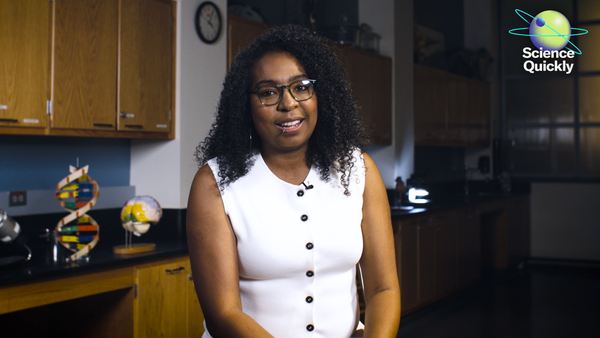
Today’s guest is Jaye Gardiner. She’s an assistant professor of biology at Tufts University, where her lab has a unique spin on cancer research.
On supporting science journalism
If you're enjoying this article, consider supporting our award-winning journalism by subscribing. By purchasing a subscription you are helping to ensure the future of impactful stories about the discoveries and ideas shaping our world today.
Thanks for chatting with us, Jaye.
So a lot of scientists study the ways that viruses and cancers can interact, but the way you’re doing it is a little unconventional and might surprise our listeners. So could you tell us more about why your perspective is so unique?
Jaye Gardiner: Yeah. So up to 20 percent of all cancers are actually caused by viruses, so if you think of things like human papillomavirus [HPV] that can cause cervical cancer, head and neck cancers, penile or anal cancers. You have the hepatitis viruses of, like, B and C that can cause liver cancer, viruses that can cause lymphomas or leukemias.
[In] all of those, the virus changes something in the cell that’s supposed to tamp down its ability to divide endlessly. So kind of at the heart of all cancers, or at least in the malignant cells, we’re thinking more about the cell cycle and trying to stop that from going on endlessly. The way that I’m thinking about it is more about the contributions to the environment.
So if you use an analogy like the seed and soil, so your tumor cell is the seed, the microenvironment is the soil that can either nourish it or keep it at bay. When our bodies are healthy, that soil is very dry and arid, so it doesn’t allow that seed to germinate. So I want to understand if ways that we have viral infections could cause that soil to be much more rich and fertile, giving all of the nutrients that’s needed to allow that seed to grow whenever it shows up.
Feltman: So speaking of that microenvironment that you compare to soil, uh, I know a lot of your work focuses on the extracellular matrix. Can you explain for us exactly what that is?
Gardiner: The extracellular matrix you can think of as the noncellular components, so no cells whatsoever. These are just, kind of, molecules that can make fibers and kind of create networks and support for your tissues. So things like collagen, that we hear a lot about, or hyaluronic acid, those are components of the extracellular matrix, or ECM.
A really great way to think about it.... So it’s really important for us to heal wounds, right? So if we cut open our hand, we wanna have that close up normally without having a scar. The scar, if it does happen, is an accumulation of the extracellular matrix, where those fibroblasts were there for too long, secreting the extracellular matrix for much longer than they should have. If we think about that now for an entire organ or for fibrosis, we’ll use the lung as an example, where you have to be able to inhale and exhale, your lungs have to expand. If you have scar tissue there, so all of this extracellular matrix being deposited, now that organ can’t function normally.
So you’ve made it, like, really hard and rigid. It can’t open and close. You can’t get the air in. That leads to complications for the patient. So if you think about that in any of the organs that we have, they all have very specific functions that usually require them to be a little bit flexible; otherwise they would’ve been hard like bone in the first place.
So extracellular matrix—incredibly important, not just for your hair and fingernails and youthful-looking skin but has a real impact in a lot of diseases as well.
Feltman: Are there any specific viruses that you’re particularly interested in?
Gardiner: So right now my interests—we’ll start with coxsackievirus, specifically clade B. Any parent out there, you might have heard of the effects of a clade A coxsackievirus, ’cause it can cause hand, foot and mouth disease, so something very common among children.
But clade B, [when] most people are infected with it, [it] just causes kind of like a common cold. So you wouldn’t really be able to differentiate it between a different virus that caused the cold. But the reason why I’m interested in it is that there have been some studies that showed that virus, even though it’s considered a respiratory virus, so it would primarily be in your lungs, can also infect your pancreas.
And for coxsackievirus in particular, B3, if we want to get very specific, you can actually cause both acute, so a short time to resolve, or chronic, a long time to resolve, form of fibrosis in the pancreas. And so fibrosis is a predisposition for any type of cancer, so now if we have a virus that can cause these long-term fibroses in an organ, now we’ve already set that soil up for that cancer when it takes off.
Feltman: So as we continue to learn more about how these different viruses can affect the extracellular matrix and contribute to cancer risk, what do you think the impact of that knowledge could be?
Gardiner: I think it would probably redefine what we think of as the causes for cancer, or at least broaden our scope in how we deal and manage with colds.
’Cause, at least with, right now, with the common cold, it’s just you kind of “suck it up.” You’re sick for, like, 10 to 12 days, maybe a week if you’re super fast. Stay at home is the good thing to do, but I don’t know if anyone’s really inquired what happens with these routine infections but also what happens to the rest of our bodies.
So I talk about the extracellular matrix and being in this three-dimensional space as being really important for, like, how cells can, like, interact and things in our bodies, so needing those cellular cues. But when we think about viruses, I feel like it’s often researched where that primary infection is.
So if it’s something that causes a cold, or a respiratory virus, you would look at it in the context of the lungs, maybe look at how it interacts with the immune system. But you’re not really looking at what happens elsewhere in the body. So that immune response, it’s not just happening only in your lungs. Like, it’s coming from everywhere else, sending the forces to try and clear the virus. And so who’s to say that it’s only staying in our lungs? I mean, for coxsackievirus, it’s already known that it can start to spread to the pancreas, but are more viruses doing that? Can more viruses contribute to cancer without directly causing the mutations to allow those cells to grow? That’s unknown.
Feltman: I’m also really curious how this relates to postviral syndromes like long COVID. And of course, there are other postviral syndromes, but, in the wake of COVID, I think people are much more aware of them.
Gardiner: Yeah. So I think COVID is a really good example of how you can have a virus that is primarily, infects your lungs or has an impact there, but then you have symptoms everywhere else.
So if you think about the migraine, so that’s gonna be in your brain, or there was that one short period where there was the COVID toe, where everyone’s toes were turning red. So that’s just, like, a very polar opposite end of the body. But with long COVID, there’s a lot more research that needs to be done to truly understand what is causing it or what is allowing for this persistent response even when the actual viral infection has been cleared.
And so I actually think that’s a really nice example of how it could be things that are in this environment, so maybe not a tumor microenvironment but more of a viral microenvironment that needs to be studied to understand how viruses, when they infect cells, are impacting more than just the cell that they infect.
Feltman: And what kind of experiments are you working on right now?
Gardiner: Hopefully, uh, this summer we’ll start kind of hitting the ground running on trying to understand a little bit more of how these fibroblasts are staying persistently on, and also starting to get some work off the ground working with coxsackieviruses and seeing: Can they infect fibroblasts? If they do, how do they change the extracellular matrix that they secrete?
Feltman: What about longer term? You know, what questions are you hoping to be working on in five or 10 years?
Gardiner: Definitely the virus side of [things]. Yeah, I think that’s my very much long-term goal of thinking more of that viral microenvironment.
But I think there’s also really interesting ways to intersect virology and thinking about the extracellular matrix in different ways, almost like how I wanna think about virology and cancer in different ways as well. So for example, during my Ph.D., I worked on HIV, and that’s a great virus that is controlled now. So we have really great treatments that if someone becomes HIV positive, they can take these treatments, can be undetected, and you can live long, full lives, unlike when the virus was first discovered, or just really amplified, in the 1980s.
However, those individuals do have a higher incidence of cancer but not because of the HIV. The HIV’s undetectable, it’s not really spreading in the body. Is the antiviral drug changing, sort of, this environment so that once a mutation in a cell that’s causing cancer, like, it allows it to take off? I don’t know, but that could be something fun, sort of these different intersections between virology and cancer biology would be fun to do in the next 10 years.
Feltman: I would also love to hear a little bit about your comics.
Gardiner: Yes! [Laughs.] So I originally wanted to go to college for illustration, and I didn’t. I chose the route of science because I thought I had to choose, and also because my high school teachers made science so much fun.
But while I was doing my Ph.D., I kind of got that itch again, and with two friends, Kelly Montgomery and Khoa Tran, we started a little group that we call JKX Comics, so J for my name, Jaye, K for Kelly and Khoa and X like a variable. So if there are scientists that don’t do art but want to have their science represented, we can draw for them, or if there are artists that don’t do the science, we can collaborate in the other direction.
But kind of what we really wanted to do is show how cool science is, get it away from the paywall. So how we publish our information or share it as scientists are in these journals that we have to pay to have a subscription and also pay to publish, that it makes it really hard to have that information accessible to someone that’s not a researcher.
But also the language that’s used is also very much inaccessible. So by using comics, it’s not necessarily geared toward children; it’s just to be a more fun way and more memorable way of conveying science. We can break down both of those barriers and show also the people that are behind the work, that it’s not just someone who looks like Albert Einstein in a basement yelling, “Eureka!” or the sort of lone wolf that isn’t working with a team. That it’s people from all walks of life all collaborating together to just try and understand our world a little bit more.
Feltman: Very cool. So can you walk me through what that process usually looks like?
Gardiner: Yeah. So you can do it at multiple levels. So we’ve done it before with sort of following a scientist and kind of the overall [arc] of, like, what their project is or what question they’re asking. So our biggest project to date is called Gaining STEAM!, and it follows about seven different scientists at the University of Wisconsin–Madison and the research that they’re doing.
So you get to learn about that specific scientist and who they are as a person and also what research they’re doing, and it’s all different kinds of disciplines. So the one I personally illustrated was for Edna Chiang. She was researching the thirteen-lined ground squirrel and trying to understand how they survive hibernation—which is really cool in the context that you might think, “Why would anyone need to know that?” But if you think about medically induced comas or just, “How are organisms able to put themselves asleep and come back awake and be completely okay when they haven’t been eating for however long?” studying animals in this context can be well applied for space travel or medically induced comas.
But so for those, we followed the scientist. We’ve also done just sort of individual portraits, so highlighting really cool individuals that did neat work, both past and present. So I think comics can be really powerful for that aspect too.
Feltman: Thank you so much for coming on to talk with us today.
Gardiner: Yeah, no problem.
Feltman: That’s all for today’s episode. For more on the inaugural winners of the Young American Scientist Awards, check out the latest print issue of Scientific American or head over to ScientificAmerican.com. You can also find video profiles of our winners on our YouTube channel. We’ll be back to our usual science news roundup on Monday.
Science Quickly is produced by me, Rachel Feltman, along with Fonda Mwangi, Sushmita Pathak and Jeff DelViscio. This episode was edited by Alex Sugiura. Marielle Issa and Aaron Shattuck fact-check our show. Our theme music was composed by Dominic Smith. Subscribe to Scientific American for more up-to-date and in-depth science news. And don’t forget to check out our summer reading challenge for a chance to win some awesome prizes! You’ll find a link to that in our show notes.
For Scientific American, this is Rachel Feltman. Have a great weekend!
