

The old expression “bird brain,” referring to a small or inadequate brain size—it’s not all that accurate. Take crows, for example, and other corvids, like jays and magpies. “Many corvids have relatively large brains for their body size, and can do amazing things.” Anders Møller, an evolutionary biologist at the French National Science Research Council. “So this ‘bird brain’ expression is a little bit simplified.” Some birds are so intelligent that they’re informally referred to as “primates with feathers.”
But even among the smartest bird species, there’s still natural variation in brain size. Which is a big deal—when it comes to being hunted. Møller worked with a taxidermy shop in Denmark, which had data on nearly 4000 birds brought in to be stuffed since 1960. A lot of the birds were just found dead—hit a window or wire—and people picked them up. But 300 of the specimens had been hunted.
So Møller’s team then compared the brain sizes of birds that got shot to those that didn’t. They controlled for the birds’ age, sex, body size, and species. And they found that the hunted specimens’ brains were actually five percent smaller, on average, than the brains of birds that died by other means. “The surprising thing is that, if you make a similar kind of analysis of liver or heart size, there is absolutely no difference there. So this is specific to the brain.” The results are in the journal Biology Letters. [Anders Pape Møller and Johannes Erritzøe, Brain size and the risk of getting shot]
On supporting science journalism
If you're enjoying this article, consider supporting our award-winning journalism by subscribing. By purchasing a subscription you are helping to ensure the future of impactful stories about the discoveries and ideas shaping our world today.
The researchers assume that individuals with larger brains had what they called “superior escape ability.” That is, they were better at not getting shot.
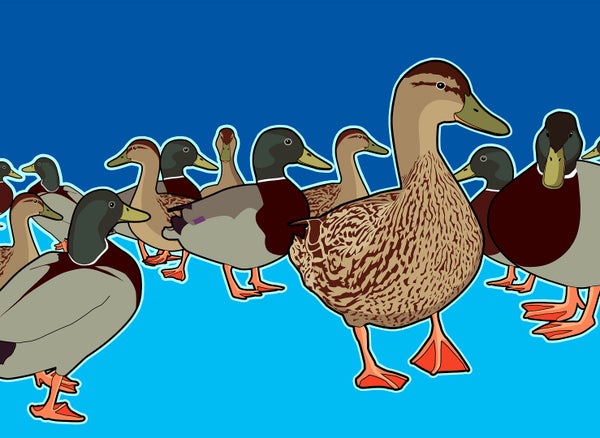
As game season begins, Møller has this observation for hunters: “When you are sitting at the dinner table and eating the duck that you managed to shoot, with all likelihood it’s one with a disproportionately small brain.” Most certainly food for thought.
—Christopher Intagliata
[The above text is a transcript of this podcast.]
