
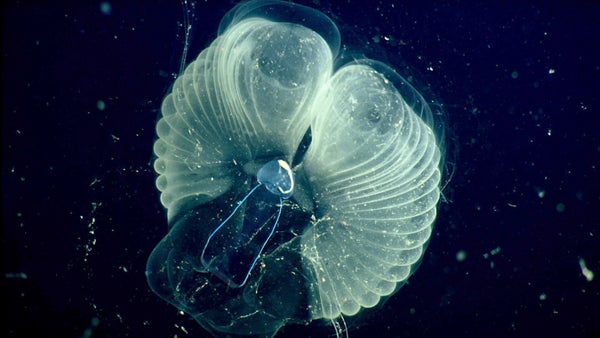

Mucus is a miraculous substance. It’s in our noses, of course—but it also helps us swallow. And it lubricates our eyes, so we can blink. But it’s not just us. Mucus is ubiquitous in the oceans, too.
“Fish are covered in mucus. There are parrot fish that excrete mucus balloons around their head, presumably to protect them against predators and parasites.”
Kakani Katija, a bioengineer at the Monterey Bay Aquarium Research Institute. As fascinating as parrot fish are, she's interested in the mucus creations of another creature called a larvacean.
On supporting science journalism
If you're enjoying this article, consider supporting our award-winning journalism by subscribing. By purchasing a subscription you are helping to ensure the future of impactful stories about the discoveries and ideas shaping our world today.
“Actually I wonder if I have one in my bag now.”
She means a 3-D printed one, not a real one.
Katija says that larvaceans look a lot like tadpoles—and even the ones called “giant” larvaceans are only about four inches long. But they excrete spectacular mucus structures around them—shaped almost like a neck pillow you’d bring on a plane but with ridges and baffles running through them. These “snot palaces,” as some people actually call them, help the animals filter ocean waters for food.
Katija’s team sent a robot diving in California’s Monterey Bay to observe those mucus mansions, as nobody appears to call them, in greater detail than ever before by shooting laser light at the larvaceans. Those expeditions have allowed the researchers to create 3-D models—which means you'll soon be able to 3-D print your own larvacean, too, if you like. And they plugged the models into a virtual reality environment ...
“So somebody can walk inside and through these filters.”
The details and lots of images are in the journal Nature. [Kakani Katija et al., Revealing enigmatic mucus structures in the deep sea using DeepPIV]
One application of the analysis is that engineers might someday derive inspiration from the mucus structures to design more efficient filters. But there’s also an element of wonder to the work as well.
“I’m just really excited that we have the capability to observe mucus in all these different forms in the deep sea.”
—Christopher Intagliata
[The above text is a transcript of this podcast.]
