

Christopher Intagliata: Within a few decades, global temperatures are expected to climb to 1.5 degrees Celsius above pre-industrial levels. And that's gonna be really bad for corals, according to the latest report out from the Intergovernmental Panel on Climate Change.
Andréa Grottoli: So the recent IPCC report says that up to 1.5 we can expect 10 to 30 percent coral survivorship. And above that, it decreases precipitously.
Intagliata: Andréa Grottoli is a distinguished professor at the Ohio State University. Amid the doom and gloom of the IPCC report, Grottoli has some rare GOOD news. Corals may be more adaptable to future conditions than we thought.
On supporting science journalism
If you're enjoying this article, consider supporting our award-winning journalism by subscribing. By purchasing a subscription you are helping to ensure the future of impactful stories about the discoveries and ideas shaping our world today.
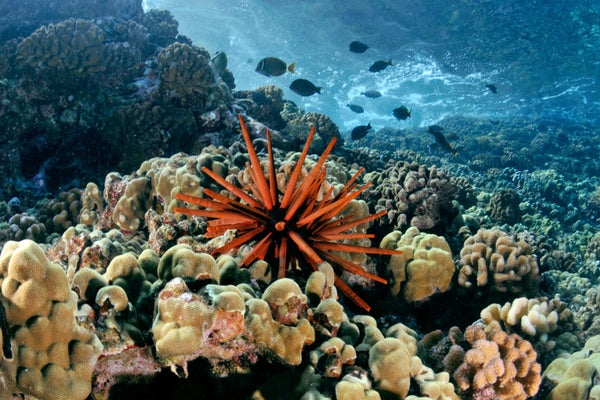
Her team studied three species of coral from the island of Oahu, in Hawaii. They put them in tanks with either heat stress; more acidic water; or both.
Grottoli: And what really matters in this study is the one where both increases in temperature and ocean acidification, because that's exactly what's happening on reefs now.
Intagliata: Twenty two months later—they assessed the winners and losers. They found that on average, more than half the corals survived. Even after being punished with warmer, more acidic waters—the kind they'd face under two degrees of global warming.
Grottoli: The corals that survived, two of the three species were actually physiologically performing normally. They were doing more than surviving. They were coping, they'd acclimatized. They were doing well.
Intagliata: The results appear in the journal Scientific Reports. [Rowan H. McLachlan et al, Physiological acclimatization in Hawaiian corals following a 22-month shift in baseline seawater temperature and pH]
Grottoli says the study provides hope the world's corals may be more resilient than we thought—especially since one of the Hawaiian species they studied is widespread around the planet. But will this good news motivate world leaders to rein in warming? Well, corals may be able to wait just a little longer to find out.
[The above text is a transcript of this podcast.]
