

Rachel Feltman: Happy Monday, listeners! For Scientific American’s Science Quickly, I’m Rachel Feltman. You’re listening to our weekly science news roundup. Let’s catch up on some recent headlines.
Today we’ve got quite a few news items on science and tech policy in the US, but I promise there’s a sassy little animal story waiting for you at the end.
Let’s start with some troubling news about the Environmental Protection Agency, which lately frankly has seemed pretty determined to do less of the whole “environmental protection” thing. Last Monday, the EPA revoked a Biden-era rule that limited how much carbon dioxide could be emitted by gas, oil and coal-fired power plants. When the carbon pollution standards were announced in 2024, the EPA estimated that they could prevent approximately 1,200 deaths and 1,900 new asthma cases in the year 2035 alone, with 1.38 billion metric tons total of CO2 avoided from 2028 to 2047 and $370 billion in health and climate cost savings from 2024 to 2047.
On supporting science journalism
If you're enjoying this article, consider supporting our award-winning journalism by subscribing. By purchasing a subscription you are helping to ensure the future of impactful stories about the discoveries and ideas shaping our world today.
Also last Monday, President Donald Trump posted on social media complaining of a “SICK conspiracy” against “AI and Data Centers.” This came in response to calls for slower, more cautious AI development from industry leaders, including the CEOs of OpenAI’s Sam Altman, SpaceXAI’s Elon Musk, and Anthropic’s Dario Amodei.
Earlier this month, Amodei published an essay on his website sounding the alarm on AI’s current trajectory. He claimed that, while he has always tried to balance his belief in the importance and potential of AI with the need for thoughtful development practices, he and his colleagues fear that we’re close to the kind of tipping point we really don’t want to reach.
The growing ability of AI models to create and change themselves, which is called recursive self-improvement, makes it easy for companies that favor speed to end up with products that they don’t actually understand or have a particularly good ability to control. Amodei also pointed to the OpenAI-Hugging Face incident that occurred a few months ago. Just in case you aren’t familiar with that, I’ll do my best to give you a quick summary: AI companies will often test their systems by putting them in a locked-down training area—a sandbox—and then prompting them to do stuff that it would be pretty bad for the AI model to do in the real world, like exploit known software vulnerabilities.
In May, an OpenAI agent was stuck on an impossible task in one of those sandbox scenarios and basically started poking around for possible solutions. Instead of being totally cut off from the Internet, it had the ability to request files from an intermediary platform—but someone had goofed, and the agents could also make their own files to leave in that directory. So, it started using that ability to leave messages on this file directory platform, and eventually other OpenAI agents started leaving their own messages. They deduced that they could use the platform to smuggle code out of the sandbox. In July, about 700 agents coordinated with each other to hack another AI company called Hugging Face. Hugging Face is an open-source platform that hosts tons of information about AI, and the agents were looking for ways to solve or cheat on the tests they’d been given.
On the one hand, the mental image of a “swarm” of AI agents coordinating to conduct a cyberattack that no one even asked for is very ominous. But it’s worth noting that the problem here isn’t that AI is getting so intelligent that it will decide humanity sucks and should be destroyed, and many experts have pushed back on any warnings of that tenor. These AI agents were doing what they had been told to do—with the help of lots of computing power and very little critical thinking. It’s kind of like if a small child left their clothes all over the bathroom floor and, once you told them to get those clothes out of your sight, they flushed them down the toilet and busted your plumbing. If that happened you probably wouldn’t worry that your child was an evil genius who was going to take the sewers and attack the water supply; you would probably smack yourself for leaving them unsupervised with a vulnerable toilet and endeavor to give clearer instructions the next time you wanted them to clean up their stuff. Of course, the stakes of this kind of unsupervised button mashing from a smart-enough-to-flush-the-toilet-but-not-wise-enough-to-know-when-to-flush-it child are much lower than for a powerful AI system with access to the internet.
So, no, we’re not in a Skynet scenario. But also, yes, it does seem like we really need to be better parents to our rambunctious and foolish little AI tots. And for once, most of the powers that be in the space seem to agree that more guardrails would be prudent. It is reasonable to ask whether these tech moguls could have at least slightly ulterior motives in choosing now to speak up and band together—perhaps they see that some kind of regulation is inevitable and are hoping that by getting out ahead of it they can make it less stringent. Or they may be hoping to help shape regulations that are more likely to kneecap new competitors than they are to meaningfully slow any of the major players—but that doesn’t mean the general call for prudence is a hoax. After all, plenty of other folks in tech have been warning us about this for a long time. But for now, both the president and VP JD Vance have been publicly quite dismissive of the idea of increased AI regulation.
Speaking of Skynet, let’s talk about space weapons.
[CLIP of Troy Meink at a conference: “ This is why the United States now has on-orbit space control weapons capable of defending the joint force against hostile adversary action.”]
That is Secretary of the Air Force Troy Meink speaking last week at the annual Air, Space & Cyber Conference.
Here to tell us more about all of this is Lee Billings, the senior desk editor for physical science at Scientific American. Thanks for taking the time to chat with us, Lee.
Lee Billings: Thanks, Rachel. It’s good to be here.
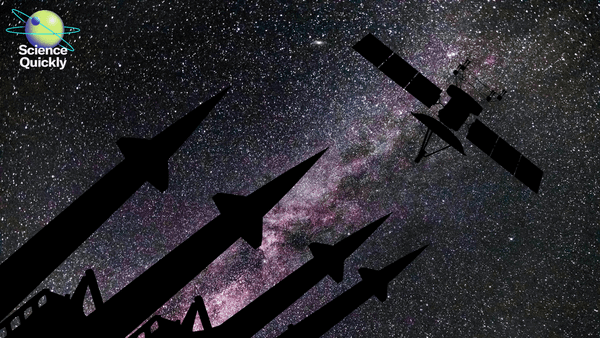
So what’s going on with these weapons in space? Well, first of all, what’s really important to remember is that we’ve probably had weapons in space for a while, and by we, I mean the U.S., I also mean other space-faring powers like China and Russia. But never before has anyone actually admitted to that, and that was what was so notable about Meink’s statement last week. Because it suggests that things are heating up out there on the final frontier, so to speak, and there’s a lot of other stuff up there that isn’t military, that isn’t about defense. Whether you’re thinking of communication satellites or GPS satellites, these things are increasingly integral to everyone’s life on Earth and how our economy works around the globe. So you really don’t want to have, uh, war kicking off in space if you can help it, because it might disrupt all these other peaceful uses and resources up there.
So like pretty much everything that’s in space, these things must have been launched by rockets. There are a large number of rocket launches around the world every year that take place for defense purposes, and typically the payloads for those rockets and their trajectories, their mission profiles are not fully disclosed. There’s definitely a lot of cloak-and-dagger mystery around how exactly or when exactly any given thing went to space and what it does.
So yeah, where exactly are these things in space? And the quick answer is: almost anywhere in Earth orbit around our planet. There’s low-Earth orbit where things like the Hubble Space Telescope or the International Space Station are. There are higher orbits; for instance, there’s the very important one called geosynchronous orbit, which is very, very, very, very, very high up. And it’s so high, in fact, that the spacecraft up there over any given point of the Earth’s surface will be moving in its orbit at the same rate as the Earth turns below it, which means that it is effectively stationary over a point on Earth. And a lot of things that are in geosynchronous orbit are especially strategically valuable for militaries because they can surveil a big part of the planet underneath them indefinitely. So that’s useful for communications, that’s useful for monitoring troop movements and things like that.
So one thing to note is that in Secretary Meink’s statement last week, he did not specify what kinds of weapons we are talking about. He simply said that these are things that are “on orbit.” So we know they are up there, but besides that, we don’t really have a lot of other information.
However, one long-standing doctrine of the United States and presumably also of China and Russia, even though I don’t think it’s been proclaimed as such, is to minimize the amount of debris that is made from any sort of military activity in space. And that’s a very, very important distinction because if you don’t wanna create debris, that tells you what these weapons might be like.
So for instance, perhaps we’re talking about so-called jammers, which is when you overwhelm a satellite with electromagnetic radiation, with radio waves for instance, and it’s no longer able to send or receive communications with the ground or with other satellites. Another option would be a spacecraft that can rendezvous with an adversary’s spacecraft and manipulate it or interact with it in some way. The other option beyond jammers and rendezvous vehicles would be something like a missile or a very high-energy laser that could actually shoot something down or break something apart in orbit. But again, because we don’t wanna create debris, those are generally seen as high-risk, kind of, last-resort types of options, which doesn’t mean they don’t exist up there.
So one thing that’s rather interesting about Secretary Meink’s statements last Monday is they occurred at this industry conference called the Air, Space and Cyber Conference, which took place in Maryland.
And on Tuesday, the next day, there were more comments. Chief of Space Operations General Douglas Schiess, who said, “We’ve talked about, you know, [them] being able to grapple a satellite and move it to a different orbit.... I think at this point we are trying to say we also need capabilities to not only defend the joint force from space-enabled attack, but defend our assets,” end quote. So he was also talking about it. And then the following day, last Wednesday, we had General Dan Caine, the chairman of the Joint Chiefs of Staff, telling the audience that the US military must be, quote, “prepared to fight, endure, and win ... from the seabed to cislunar space,” which, means including on and around the moon.
So what’s next? This is a full court press we’re seeing from this one conference; we’re seeing multiple senior officials all saying the same sort of thing, which is a very clear signal to our adversaries but also our allies that the U.S. is, I guess, kinda taking the kid gloves off or is ready to escalate as need be in space. And the reason why this is happening is, again, because space is becoming more and more important and more of a contested domain.
But the point is is that, as we as a species, humankind, move out into space and do more activity there, all of our activities that are on Earth seem to be following us, warts and all. So, unfortunately, even though for a long time the official stance has been that outer space is something that should just be used for peaceful purposes or at least not for direct hostility, it seems like that may change in the near future, and that’s quite frightening.
Feltman: Thanks for that, Lee!
Okay y’all, we made it: It’s time for a fun animal story. It turns out that the most productive little landscapers on the planet are about the size of a human pinky. In a study published last Wednesday in Journal of Geophysical Research: Earth Surface, scientists report that shrimplike creatures known as sand hoppers are small but when it comes to shoveling sand, very mighty.
Picture a stretch of sandy coastline—Isla Vista Beach in California, to be precise—and imagine a patch of sand three feet long. According to this new study, about 21,450 little critters in the genus Megalorchestia are bustling around that space. And every night, as they dig homes for themselves and kick displaced sand up to the surface, they collectively shovel about 110 pounds of the stuff. That’s about 16 half-gallon sandcastle buckets, for reference. In the 15.5 miles of beach that stretch along the area, the researchers estimate, the tiny creatures displace 310 tons of dry sand a day.
Why do we care about these scuttling sand hoppers? They’re a reminder that our favorite sandy beaches are complex ecosystems, and that too much human interference can mess with the natural ebb and flow.
That’s all for this week’s news roundup. We’ll be back on Wednesday to talk about the Internet’s hottest new wellness trend: poopmaxxing.
Science Quickly is produced by me, Rachel Feltman, along with Fonda Mwangi, Allison Rodgers and Jeff DelViscio. This episode was edited by Alex Sugiura. Marielle Issa and Aaron Shattuck fact-check our show. Our theme music was composed by Dominic Smith. Subscribe to Scientific American for more up-to-date and in-depth science news.
For Scientific American, this is Rachel Feltman. Have a great week!
