New Issue: Orbital Catastrophe Ahead? Read Now

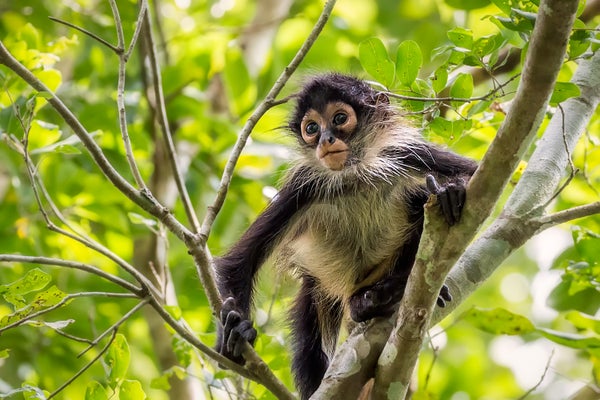
Spider Monkeys Optimize Jungle Acoustics

The monkeys lower the pitch of their "whinnies" when they're far from the rest of their group, which might help the calls travel further through jungle foliage. Christopher Intagliata reports.

Illustration of a Bohr atom model spinning around the words Science Quickly with various science and medicine related icons around the text

Join Our Community of Science Lovers!

The hardest part of chasing monkeys through the jungle isn't the snakes. "The snakes aren't going to attack you if you don't have contact with them." It's simply keeping up with the monkeys. "They are jumping from one tree to another tree so they don't care if the landscape is difficult or if there is a river."

José Domingo Ordóñez-Gómez. He’s a primatologist at the German Primate Center in Göttingen. The reason he was pursuing 35 spider monkeys through the rainforests of southern Mexico was to record their whinnies. 

By analyzing more than 500 calls, he found that when a monkey was separated from the group by more than 40 meters—or 130 feet—it produced a lower-pitched call than when the same monkey was nearby the group. Ordóñez-Gómez thinks the pitch choice may be because lower-frequency calls are better suited to travel long distances through dense jungle.


On supporting science journalism

If you're enjoying this article, consider supporting our award-winning journalism by subscribing. By purchasing a subscription you are helping to ensure the future of impactful stories about the discoveries and ideas shaping our world today.


The findings are in the journal PLOS One. [José D. Ordóñez-Gómez et al., Acoustic variation of spider monkey (Ateles geoffroyi) contact calls is related to caller isolation and affects listeners’ responses]

Ordóñez-Gómez also found that other spider monkeys responded back more quickly when they heard one of the low-pitched calls, compared to regular whinnies—perhaps, he says, because the deeper calls really get the attention of eavesdropping monkeys. A relatable feeling for any human primate who's heard a crying baby.

—Christopher Intagliata

[The above text is a transcript of this podcast.]

Subscribe to Support Independent Journalism

Great science journalism requires human expertise, time, effort and creativity. And it costs money. That’s why I and the journalists here at Scientific American hope you’ll join our community.

When you subscribe, you are supporting staff and freelance journalists who are passionate about telling science stories that are true, important and compelling. Our editors and reporters are often experts in their fields, which means they understand the nuances of big discoveries and can untangle the breakthroughs from the hype. With a subscription, you are also supporting rigorous fact-checking to ensure the words we publish are precise and accurate. And you’re supporting original illustrations, graphics and photos that bring you closer to an advanced laboratory, an ice sheet in Antarctica or a space mission in orbit. You’re helping us craft other types of high-quality journalism as well: Our newsletters are carefully written, edited and curated by staffers you have or will come to know and love. Our Science Quickly podcast is based on original reporting, collaboration with editors and scientists and exacting production.

Subscriptions keep this engine running so we can continue to deliver thoughtful, rigorous and independent science journalism to you. In an era of viral misinformation, this work is crucial. If you value what we do, I hope you’ll consider joining us as a subscriber

Thank you,

Jeanna Bryner, Editor in Chief, Scientific American

Subscribe