

Rachel Feltman: Hey listeners, it’s Rachel here. Before we get into today’s episode, I just wanted to acknowledge our unexplained absence from your feed over the last few weeks. To make a long story short, Scientific American was sold to a new parent company in June, which caught our team by surprise. There were lots of things to sort out during the transition from Springer Nature to LabX, but now we’re back at work on the pod. We’re sorry for the hiatus was so abrupt, but the good news is that Science Quickly isn’t going anywhere! Thanks for your patience as we get back up to speed. Without further ado, here’s a new episode for you to enjoy.
For Scientific American’s Science Quickly, I’m Rachel Feltman.
I’ve always had a love-hate relationship with the sun. As the sole alabaster-skinned outlier in an otherwise solidly Mediterranean family, photographic evidence can confirm that, despite my parents’ good-faith efforts, I spent most of my childhood very, very sunburned. On one infamous trip to Aruba, I got second-degree burns across my shoulders that were so bad, I spent a week covered in zinc diaper cream for extra protection.
On supporting science journalism
If you're enjoying this article, consider supporting our award-winning journalism by subscribing. By purchasing a subscription you are helping to ensure the future of impactful stories about the discoveries and ideas shaping our world today.
While my SPF needs may have been considered offbeat and a little bit fussy back in the mid-1990s, we’ve since come a long way when it comes to societal attitudes around sun protection. The popularity of tanning lotions and baby oil have given way to cutting-edge sunscreen formulas, including plenty intended for everyday use. In fact, earlier this month, the U.S. Food and Drug Administration approved the first new sunscreen ingredient in 27 years.
At the same time, we’re starting to see a backlash to that wave of skin cancer prevention messaging about sun exposure—including from people in the White House. And while science definitely doesn’t support the use of tanning beds or endless, unprotected sun exposure, it is true that there could be a bit more nuance to the question of how much sunshine to seek out than you’ve been told.
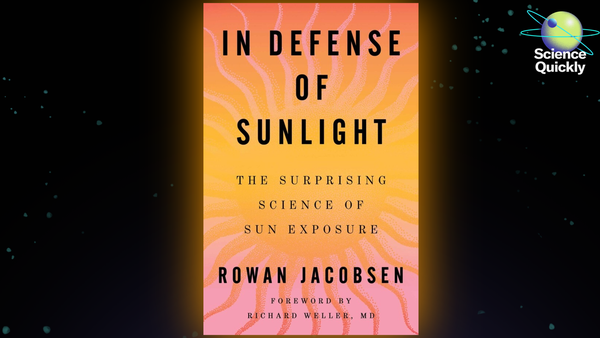
Today’s guest is writer Rowan Jacobsen. He’s the author of a new book called In Defense of Sunlight: The Surprising Science of Sun Exposure. He’s here to unpack the latest research on the risks and benefits of unadulterated sunshine.
Thanks so much for coming on to chat with us today.
Rowan Jacobsen: Thanks. I’m excited to be here.
Feltman: So we’re in a pretty weird place right now with sun exposure in the U.S. You know, we have the mainstream medical guidelines on one end, and then we do have people in the White House trying to make it easier for teens to use tanning beds. So with that in mind, I would love to start at the top by making it clear what your book is not saying. You’re not busting open an antisun conspiracy and telling us that the science says we should throw away all sun protection forever and tan with abandon. Is that correct?
Jacobsen: Yeah, that gang is doing me no favors right now.
Feltman: But how did you get interested in the topic of the sun and, you know, in defending it? Because it turns out there is nuance to some of these recommendations that we have.
Jacobsen: There is a lot of nuance, which is why I decided a book was the right format so that you can actually get into all the nuance of it. But for me, it started about 10 years ago, when a few studies hit the scientific literature showing that sunlight actually had some beneficial qualities that we hadn’t previously taken into account.
So then, you know, you start asking, “Well, we know that sun has these negative qualities related to skin cancer, and the recommendations that existed, that you referred to, were based purely on that. But if suddenly we have these benefits, then does that mean we need to reevaluate the relationship there?” And so my book asks that question and tries to dive in and do that at some level.
Feltman: So how did we come to our current mainstream recommendations when it comes to sunlight?
Jacobsen: So basically, for a really long time, like 100 years, the one thing we knew that sunlight did that was good for you was vitamin D. When sunlight hits skin, it makes vitamin D. And we learned that, yeah, in, like, the 1920s, [in the] 1930s, 1940s, scientists started to discover that the ultraviolet light in the solar spectrum can cause skin cancer.
So suddenly, everybody had been very prosun up to that point. Suddenly, you know, they went, “Well, we gotta reconsider this ’cause it looks like too much sun exposure will raise your risk of skin cancer.” We learned more and more from there about those dangers, and at the same time, skin cancer rates in the U.S. started to explode after World War II, basically.
So it started to look like we had kind of an epidemic on our hand. So the warnings got more and more strident that you better be careful with sunlight. We still had the issue of vitamin D; we didn’t want people to be deficient in vitamin D, but you can also make a pill, and people could get vitamin D through their pills.
So basically, the current recommendations to avoid all sun exposure were based on the concept that you could make up for that by taking a vitamin D pill, and that would give you all the good stuff that you weren’t getting from the sunlight. And it has turned out that neither one of those—that calculus was not right. It turns out the vitamin D pills don’t do what the sun does and that vitamin D is only part of the story for what the sun actually does.
Feltman: Yeah. So tell me more about the growing body of evidence that maybe this total avoidance of the sun when possible is not ideal.
Jacobsen: So it kind of starts with these big observational studies. Like, you just look at populations, and you can estimate how much sunlight those different groups are getting, and what we always see across the board, no matter where those studies are done, is that the people exposed to more light on average tend to have lower rates of a whole lot of diseases and better longevity than the people who don’t get much sun exposure.
So you know, like, observational studies, they don’t prove causation, but we do have quite a bit of evidence that shows, like, sun avoidance seems to be bad for people for ways that we’re still trying to figure out. So we knew about vitamin D, but then, since then, we’ve also discovered some other good things that the sun does.
The sunlight hitting skin also produces nitric oxide, which can lower blood pressure, and because cardiovascular disease is the number one killer around the world, lowering blood pressure can make a big difference in terms of overall public health.
Feltman: Right.
Jacobsen: Sun also seems to sort of dampen an overactive immune system for reasons we’re still trying to figure out, and it seems to, like, improve metabolism a little bit. Those are kind of the big ones.
Feltman: And what do we know, if anything, about the mechanisms that might be at play here, both, you know, with the literal sun exposure itself and with maybe, you know, some other potential correlating factors?
Jacobsen: Right. It’s so fascinating, and it gets really complicated really fast. So sun hits skin, it makes vitamin D. That actually has a ton of effects on the body that don’t seem to be replicated by a vitamin D pill. Nitric oxide, which I mentioned, is produced in the skin when sun hits it from nitrates, and nitrates, we get through our food supply; if we eat a diet that’s high in leafy greens and root vegetables, those are really high in nitrates. The body stores a lot of those nitrates in the skin—it seems like specifically so that the sun will hit those nitrates and break those molecules apart into nitric oxide as needed, and nitric oxide then diffuses through the body, and it’s a well-known dilator of blood vessels. So when that nitric oxide hits your bloodstream, it lowers your blood pressure. So that’s probably a biggie.
And going back to the population-wide surveys that I mentioned that show more light exposure associated with better mortality, the big factor in all of those studies is always cardiovascular disease, which is the number one killer. So that seems to be part of the story.
And then just the general effects on inflammation and metabolism—this is more confusing. We’ve known for a long time that sunlight will actually suppress the immune system. Like, there’s a whole bunch of signaling molecules that get sent into the body by the skin when it detects light. So this—it kinda is part—seems to be part of this, like, complex system of observation in a sense. Like, the skin has lots of light-detecting proteins in it, same way that our eyes do, and part of what it seems to be doing during the day is trying to let the rest of the body know exactly what’s going on out there. ’Cause if you’re, like, a cell in the middle of the body somewhere, you have no idea what’s going on out there. You’d love to know. It affects your circadian rhythms, like when you do what during the day, like when you raise your activity, when you start working on repair, when you can expect food to come in—it’s all based on these circadian clocks, and the skin is turning out to be one of the main regulators in that clock network. So it seems like the skin is—it helps keep us, like, on our path during the day and during the night and feeds important information to the body through all these signaling molecules. But it’s early days. We still gotta learn a whole lot more.
Feltman: Yeah. And how do we know that this isn’t mostly coming from just being outside, which is more pleasant than being inside?
Jacobsen: Exactly, right? Like, with all these, you know, environmental factors, it can be really hard to tease out correlation and causation. Maybe people who go outside are healthier than people who stay inside in the first place, so it’s reverse causation. Like, we do know a lot about the mechanisms, but because you can never be sure what’s what, and because in real life there’s always, like, multifactorial things going on.
That’s why I—actually, in the book, I kind of default to this safe, actionable position, which is just what you said: Go outside, right? Because, like, it’s hard to say what are the exact factors that are making people who spend more time outside so much healthier than people who spend time inside.
But what we can say is that it looks like something about indoor life is not healthy for human beings in general—at least not the incredibly large amount of indoor life we now get. Like, the average person spends, like, 23-plus hours inside, and we have pretty solid evidence that ain’t great for us. So basically, anything that gets you outside is probably a good move.
Feltman: Yeah. Well, and you know, of course, it’s not like sun exposure is totally without risk. So could you tell us, you know, where the science is on that currently, you know, for people to keep in mind as they pursue more time outside?
Jacobsen: Right. Yeah, and it gets really—it gets nuanced pretty quickly. We know that more sun exposure raises your risk of skin cancer. That part’s pretty solid. Surprisingly, skin cancer is not a huge cause of mortality, and, like, serious morbidity. We hear a lot about it. It’s very common, but the ones that are common are the ones that don’t tend to have major health impacts, and the ones that are much more dangerous, like melanoma, are not so common; melanoma only accounts for 1 percent or 2 percent of skin cancers. So when you do go outside, you know, get moderate amounts of sunlight, it has a minimal effect on raising your risk of skin cancer. That turns out to be, like, just like a rounding error in your overall health. What looks to be a bigger factor is a history of sunburns, especially early in life. That associates with higher rates of melanoma. And that’s the one you want to avoid for sure.
Melanoma’s weird compared to the other skin cancers. It actually does not correlate with lifetime sun exposure, which is bizarre. It’s more about sunburns and intermittent sun exposure. Outdoor workers have lower rates of melanoma than indoor workers—weird. But it seems like melanoma is driven by, you know, basically “live indoors and then get fried on vacation,” possibly.
It occurs at much higher levels in people with very fair skin. So it’s—that phenotype has to be really careful. And one of the other things I talk about a lot in the book is that we probably need to get away from these one-size-fits-all recommendations. Like basically the recommendations now are designed for that phenotype, that super fair, never tans phenotype, which really does need to worry a lot about skin cancer. And basically they set the recommendations for that group and figured, like, “Oh, it can’t hurt for everybody else to follow those.”
Now we know people with darker skin, yeah, maybe can have their own set of recommendations, and they’re still working out what that would look like. Like, it gets really complicated, and having a complicated and nuanced public health recommendation is tough. But it’s probably important for people who do have darker skin and are much less susceptible to skin cancer and are probably in a position to really, like, reap some of the benefits of sun exposure.
Feltman: Hmm. And has anyone started to do the work of sort of breaking out recommendations based on skin tone?
Jacobsen: Great question. Yes, and surprisingly, the first group to do that was Australia. Like, the authorities who set the recommendations in Australia got together, had a big conference about it. They did a really good job of it, and they eventually broke it up into three sets of recommendations depending on skin tone, like very fair, dark and then in the middle, with different amounts of sun exposure recommended for each of them. And they released it in Australia. It’s been a mixed bag, like, from what I’ve heard. They got some feedback from doctors that it was too complicated for a lot of people to grapple with. So we’ll see where they go with that. But, like, the, the fear is that if you tell some people that a little sun is good for them, people will do what people do and be like, “Oh, well, maybe a lot is even better for me,” you know? So public recommendations get confusing fast.
Feltman: Yeah. It seems like, you know, maybe a good baseline is to remember that a sunburn is never good for you under any circumstances.
Jacobsen: Exactly. That is what the most of the experts I consulted said to me, that, like—I was like, “Where do you guys come down on this?” And they’re like, “Make sure you never burn.” We know that sunburns are really bad, and just to be safe, you know, stop way short of a sunburn. And probably that modest, like, garden-variety sun exposure, a few minutes when you’re out and about, you probably don’t need to worry about that stuff unless you’re incredibly susceptible.
Feltman: So how has this changed your own relationship with the sun and being outdoors?
Jacobsen: It really has. And, uh, it made me realize that by internalizing this idea that, you know, “sun bad,” I’d probably, like, I’d lost a little joy in being out in the sun. And learning all the science related to the subject sort of brought that joy back to me. It’s like, oh, that morning light hitting me, not only does it feel great; it’s probably doing some good things for me. And so the—it kind of restored that relationship a little bit and, and allowed me to feel great about the outside world again.
Feltman: Awesome. Well, thank you so much for coming on to chat with us. This has been super interesting.
Jacobsen: Thanks. This was super.
Feltman: That’s all for today’s episode. While you’re spending time outside—with the appropriate level of sun protection, please and thank you—don’t forget to bring along a book so you can keep up with SciAm’s Summer Reading Challenge. You can find a link to more info about that—including how you can win exclusive prizes by participating—in our show notes.
Science Quickly is produced by me, Rachel Feltman, along with Fonda Mwangi, Sushmita Pathak and Jeff DelViscio. This episode was edited by Alex Sugiura. Marielle Issa and Aaron Shattuck fact-check our show. Our theme music was composed by Dominic Smith. Subscribe to Scientific American for more up-to-date and in-depth science news.
For Scientific American, this is Rachel Feltman. See you next time!
