
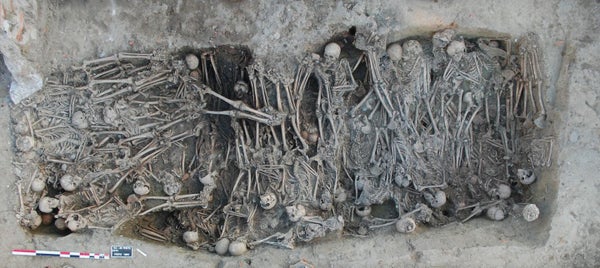

The Black Death. Also known as the Great Plague, it spread across Europe between 1346 and 1353 and brought a swift but very painful demise to up to 60 percent of the population—perhaps 200 million people in all.
A bacterium called Yersinia pestis causes the plague. It’s transmitted to humans by fleas.The insects hitched rides on the black rats that flourished along trade routes, aiding the spread of the plague.
“The Black Death was part of a larger pandemic that occurred in Europe and in the nearby regions between the 14th and 18th centuries. And it is, by many, considered to have been the most deadly of the three pandemics of plague that have occurred throughout our history.”
On supporting science journalism
If you're enjoying this article, consider supporting our award-winning journalism by subscribing. By purchasing a subscription you are helping to ensure the future of impactful stories about the discoveries and ideas shaping our world today.
Paleogeneticist Maria Spyrou of the Max Planck Institute for the Science of Human History.
“By analyzing ancient DNA from past pandemics and coupling that together with archeological and also historical evidence, we can really begin to build the history of those pandemics in great detail.”
Spyrou and her team of disease detectives teamed up with archaeologists, looking for clues to the plague’s arrival in Europe and its subsequent pattern of dispersal. Visiting old cemeteries across the continent, they sampled DNA from people who had likely succumbed to the plague—specifically, from their teeth.
“During a person’s lifetime, the teeth have many blood vessels that are going through them, and they are sort of encapsulating any bacteria or viruses that may have affected the blood of this individual during their lifetime. And therefore, what we think is that by sampling those teeth, we have increased chances of really capturing the DNA of blood-borne pathogens like Yersinia pestis.”
The researchers then reconstructed the genomes of the plague bacteria from different sites. Based on the location of the most ancestral strain of bacteria,they think the pathogen most likely first arrived in eastern Europe before spreading rapidly across the rest of the continent. But as it dispersed, Spyrou says, it picked up just a single genetic mutation.
“So in other words, what we think we’re finding here is that the Black Death in Europe was caused by a single clone. So a single strain.”
The finding suggests that the plague was introduced to Europe just one time. Only later in the pandemic did the pathogen diversify, creating local reservoirs of infectious agents across Europe. The study appears in the journal Nature Communications. [Maria A. Spyrou et al.,Phylogeography of the second plague pandemic revealed through analysis of historical Yersinia pestis genomes]
Spyrou says the strain of Yersinia pestis that set off the Black Death is now itself extinct. But its legacy is a sobering reminder of how a single microorganism can bring an entire continent to its knees.
—Susanne Bard
[The above text is a transcript of this podcast.]
