
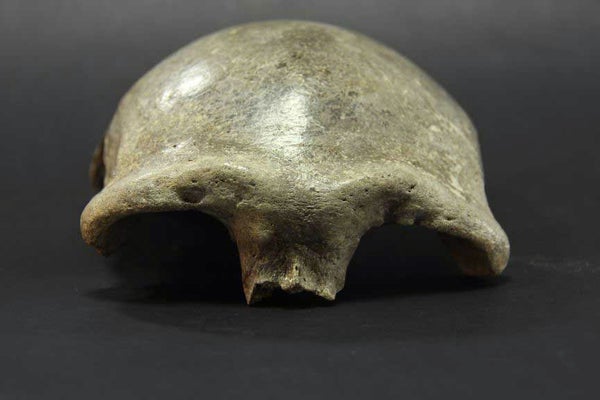

Much like modern humans, the Neanderthals roamed widely throughout Europe. We know because they left behind extensive evidence, usually bones or tools.
But their cousins, the Denisovans, are more mysterious. Until recently, they were conclusively linked only to a single cave in southern Siberia, called Denisova Cave, between Kazakhstan and Mongolia. There, scientists had found a finger bone, three teeth, and a piece of skull, which tipped them off to the existence of a whole new lineage of ancient human.
Now, scientists have uncovered more of the range of the Denisovans, says Diyendo Massilani of the Max Planck Institute in Germany. His team turned up evidence the ancient humans occupied a high-mountain cave on the Tibetan plateau, called Baishiya cave.
On supporting science journalism
If you're enjoying this article, consider supporting our award-winning journalism by subscribing. By purchasing a subscription you are helping to ensure the future of impactful stories about the discoveries and ideas shaping our world today.
"The cave belongs to monks, and monks think it's a very holy place."
In fact, a monk found a piece of jawbone there in 1980, which has been tenuously linked to the Denisovans. But Massilani and his team have now unearthed more conclusive evidence by sifting through cave sediments, and sequencing the genetic evidence the Denisovans left behind.
"Body decay. Or people bleeding, or pooping, peeing there, they could leave their DNA."
The DNA appears in layers—suggesting the Denisovans inhabited the cave as far back as 100,000 years ago, as well as at 60,000 years ago, and perhaps even as recently as 45,000 years ago—meaning the Denisovans might have overlapped in this region with modern humans.
The results appear in the journal Science. [Dongju Zhang et al, Denisovan DNA in Late Pleistocene sediments from Baishiya Karst Cave on the Tibetan Plateau]
Massilani says this method could enable more Denisovan detective work, too.
"There's so many caves where we have evidence of human activity but we don't have hominin remains. So if we can explore the sediment we can actually start to track down in the sediment the Denisovan DNA."
Denisovans live on today in the genomes of some modern-day humans, from the South Pacific. Further genetic work like this might give scientists more clues where early Homo sapiens first met—and mixed with—the elusive Denisovans.
—Christopher Intagliata
[The above text is a transcript of this podcast.]
