

Rachel Feltman: For Scientific American’s Science Quickly, I’m Rachel Feltman.
It’s no secret that most of us could do with going out and touching some grass. But for some scientists, touching grass is much more than a metaphor for logging off—and watching grass grow is anything but a waste of time. In fact, for people like today’s guest, grass—sorry, turf—is more, even, than a mere occupation. It’s a calling.
While this passion for low-profile plants might strike many as strange, their work is about to have a huge impact on the most-watched sporting event in the world.
On supporting science journalism
If you're enjoying this article, consider supporting our award-winning journalism by subscribing. By purchasing a subscription you are helping to ensure the future of impactful stories about the discoveries and ideas shaping our world today.
For around five years, turf experts from the University of Tennessee, Knoxville, and Michigan State University have been tasked with solving the surprisingly complex puzzle of preparing North American stadiums for FIFA World Cup gameplay. They’ve spent that time researching bespoke blade blends, testing cutting-edge growing methods and gaming out the logistics of cross-country turf shipment. With the World Cup now just a day away, they’re hoping for the ultimate sign of success: grass that nobody particularly notices one way or the other.
Our guest is John Trey Rogers III, a professor in turfgrass management at Michigan State University. We spoke to him late last month about the challenges he and his colleagues faced when they were tasked with pitching the best turf options to North American stadiums.
Feltman: Thanks so much for coming on to chat with us.
John Trey Rogers: Absolutely.
Feltman: A lot of people hear turf, and they think Astroturf, but FIFA demands real grass, at least partially. So why don’t we start with just: What exactly are we talking about when we talk about the turf being used at these games?
Rogers: This is real grass. This is natural grass. My discipline calls this turfgrass. When we think about artificial, we go ahead and put the word artificial turf in there, or synthetic turf. So all of those will work. And certainly, FIFA, to my knowledge, has not played a Men’s World Cup game on anything but natural grass since its inception. So they’re not going to change that for 2026.
Feltman: Yeah. And is that different from what most of these stadiums would usually be using?
Rogers: So, yes, here’s the rub of this whole thing, right? Is that FIFA identified 16 cities and in three countries: three in Mexico, two in Canada and the rest in the United States. And of the 11 in the United States, seven of those 11 multiuse stadiums whose grass or whose surface, playing surface, typically is artificial.
So this was not gonna work for FIFA. And so the job that they gave Michigan State University and the University of Tennessee was: help us solve the idea of getting a natural turf field in for the 2026 World Cup games into these stadiums that were not built for natural grass. Oh, and, by the way, five of the 16 stadiums will be in domes, which certainly weren’t built for natural grass, with one small exception in Houston.
And so come up with solutions, Michigan State University, come up with solutions, University of Tennessee, and we want evidence-based research, and that’s what we’ve been doing since basically 2020.
Feltman: Wow. So let’s, you know, at the beginning, you know, how did you select what the best species of grass would be?
Rogers: Well, there’s some basic thoughts here. Number one is that the best cool-season grass that we can use is a mixture of Kentucky bluegrass and perennial ryegrass. Now, this is outside in many people’s home lawns, this is outside in many stadiums today, but it’s just not gonna be managed as intensively as it’s going to be managed for this event.
The other grass is a warm-season grass called Bermuda grass. Now, there actually was a couple of other choices in warm-season grasses besides Bermuda grass, but we wanted to keep this very simple, so the Bermuda grass was our choice, and this is the one that’s used mostly around the world.
So now we’re down to basically two grasses: It’s either a cool-season grass—bluegrass, ryegrass—or it’s a warm-season grass—Bermuda grass. Now it’s basically: fit which grass is going to fit into which stadium. May seem complicated, but at the same time, the five dome stadiums, interestingly, even though we bring in supplemental light, we’ve got grow lights to grow this grass. They’re not strong enough to support what a warm-season grass would need. So all the cool-season grasses will be in dome stadiums. This is significant, and this blows people’s minds. Why? Because we’re talking about Houston and Atlanta and Dallas, where it could be 105 degrees [Fahrenheit] outside, and the cool-season grass would burn up in the heat, but it’s not gonna be in the heat. It’s going to be inside, where it’s 72 degrees or 73 degrees [F], in a temperature that it’s going to be able to survive. We’re just going to need to put lights on that, and all of those provisions have been made. Now you turn around to warm-season grasses, and there’s two Mexico stadiums who are gonna have warm-season grass: Monterrey, Guadalajara, and then we’ll also have warm-season grasses in San Francisco, Kansas City and New York/New Jersey.
This probably makes sense. They’re very hot and humid places. And also Miami, which makes even total sense. One that won’t make a lot of sense to a lot of people is that in Mexico City, which is the farthest south, we are gonna have a cool-season grass: perennial ryegrass and Kentucky bluegrass.
’Cause our research showed, and we went down and showed Azteca Stadium [Banorte Stadium] and all the people that worked there, “This was the best grass for you because of your altitude. You’re [nearly] 8,000 feet above sea level. You don’t get as warm as you think for using a warm-season grass, so we would like to have you consider changing grasses.”
We do a series of experiments. They did, and they agreed, and, you know, this is another of the accomplishments of Michigan State University and the University of Tennessee staff, graduate students and professors.
Feltman: As somebody who is realizing that I, I know basically nothing about grass, about how many species are there that, you know, sort of fit into the group of what a layperson would, would just recognize as, you know, grass that you might have on a lawn or in a stadium?
Rogers: I think there’s around 20 grasses around the world that you could say people will use. And I would say there’s around 20 that, if you were in my beginning turfgrass class, that I would teach you to identify, and that’s kind of an overwhelming number for a lot of people, right?
Feltman: Sure.
Rogers: And so the first thing that’s learned in turfgrass 101 is: there’s no such thing as the perfect turfgrass. No one size fits all. Every grass has an Achilles’ heel. Nothing’s perfect. And ’cause—if it was, I always remind the students, why would you be here? We wouldn’t have anything to talk about. We would just plant the grass and walk away. So grass has to fit a situation. Like you said, you don’t think about it, and then when you start thinking about it, you realize it’s pretty complicated, and it’s kept a guy like me enthralled for 40 years.
Feltman: So for the, the FIFA grass, I know that it, you know, it goes through a lot of wear and tear during the World Cup games. So I’ve heard that it, it’s reinforced. What does that mean, and how does it affect the growing process?
Rogers: Really doesn’t affect the growing process. The reinforcement is a kind of a synthetic, like an artificial, at this point, and it’s in one of two forms. You can either reinforce it using fibers that get kinda stitched into the ground, literally with seven-foot-wide sewing machines on one-by-one-inch centers, or it can be prepared as a carpet, a synthetic carpet with very open backing, and then that is prepared at a sod farm and brought in.
So we have both, because each city got to kinda choose what they wanted. Three stadiums will use the carpet, the others will use the stitch. And the stitch normally is done after the sod is installed.
Feltman: And what are some of the unique challenges of growth and, and transport that you guys had to think about?
Rogers: So let’s just take the cool-season grasses in the dome stadiums. When you think about where Dallas and Houston and Atlanta are located down in the South, Southeast, and we need to grow the grass in a northern climate, all those grasses had to come from just outside of Denver, Colorado.
So that meant they had to be transported, you know, well over 1,000 miles in some cases. Same type of thing as the stadium at Los Angeles. Their sod came from central Washington. So this obviously means that you have to take great care, and everything has to travel in refrigerated trucks so that it doesn’t heat up.
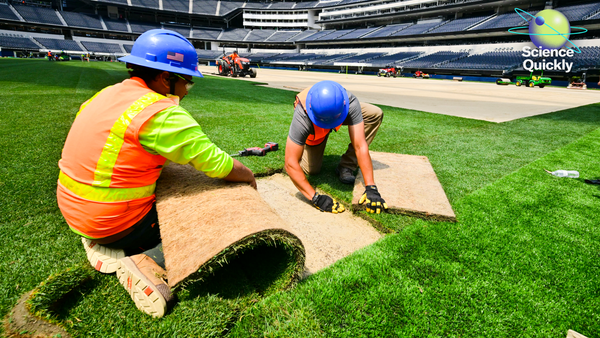
And then something we haven’t discussed yet is the preparation of the sod. The preparation of the sod is something that’s very unique to the United States and the United States alone at this point, and that is called growing sod on plastic—big sheets of plastic. And the best way for me to describe it to you and to your listeners is that if you think about a flower or a plant that’s in a pot, and you were to lift that whole thing out, it would all come out, and the roots would be stopping right at the edge of the pot, and that’s what sod on plastic is. So we establish the grass, and the roots grow down to the plastic, and then they start growing laterally. And this makes for very strong sod that, you know, is very strong as far as moving around. But the most important thing is when you transplant it, you’re not putting it into any physiological shock.
And anybody that’s ever dealt with a home lawn or dealt with any type of grass and has had sod brought in, they know the very first thing is: Boy, if you don’t water that sod for a week, it’s gonna burn up and die. And the reason is, is ’cause the plant has to reestablish, totally reestablish a new root system.
Well, not with sod on plastic, not in the way that we are delivering sod from the farms to the stadiums. It’s all being done as sod on plastic. Couple of exceptions, but at the same time, this has been one of the big keys to success.
Feltman: Yeah. And what’s the timeline like? Today it’s May 26. You know, how long before the games is the sod going into the stadiums?
Rogers: Well, the sod is in every stadium except one right now. There’s one left to go, and that’s Houston, and it is actually going in the last week of May, so right about now. And there’s others that have been in a little bit longer than that, as they have been doing some test matches—but not dome stadiums, places like Boston and Seattle that wanted to do some test matches—because, you know, you have to remember is that, if you’ve been a stadium that hasn’t had natural grass in it, and then all of a sudden we build you a natural grass field, you, you kinda gotta learn your animal. You kinda gotta learn how the grass is gonna react. Are there little idiosyncrasies that you’d like to know about? And you have a lot of stadiums that, this is where they do grow natural grass, Kansas City, Philadelphia, San Francisco, Miami. Well, that’s not something that they had to get necessarily used to ’cause they’re always grass. So it’s been very complicated. It’s a very complex situation.
Feltman: So I guess a natural question that arises for me is: I’m not gonna ask you to say whether this is worth it, but sort of, what is it that makes FIFA feel so strongly about using real grass, and how much does it actually impact play?
Rogers: The best leagues in Europe are always played on natural grass. And so what you have, majority of the best players, even if you’re from Australia, if you might be playing in one of these European leagues ’cause that’s really some of the strongest soccer leagues.
But they’re played on natural grass, and so that’s what they are very used to. And you have to realize that you get the best performance by being able to play on something that you’re used to, and that’s really been driven into us. Even some of these, the reinforcement, they have the reinforcements in Europe, and so they’re used to that as well.
And so FIFA wants to try to get the best performance out of everyone, and so the natural grass is the way. And, you know, one of the things that is a great challenge for us is trying to make these grasses all play the same. And again, these are the best in the world, so they know when something doesn’t bounce as well. They know when something isn’t as fast, when the ball, quote, unquote, “sticks.” And you say, “Is that really something that they can tell?” Yes, it is. It is no different than a professional golfer being able to tell you that a green is reacting different. So you’re the best in the world, and you get paid millions of dollars to perform.
Obviously it’s not my world, as far as performing for soccer. Preparing a soccer pitch has become my world, obviously, so.
Feltman: Yeah. Has it been fun, the challenge over these last few years?
Rogers: Fun. Fun’s a good word. Intense is a good word. I’ve spent a lot of time in an airplane, looking at sod farms, ’cause all these sod farms, they’re located all through North America, so I had to see them all. Many, many times I did, and so did my colleague John Sorochan, ’cause this was something that FIFA really counted on us to do as the agronomist, to bring this in.
So it’s been intense, but it’s been very enjoyable because I’ve had three wonderful graduate students, all of which have gotten, one [has] gotten a master’s, one’s achieved her Ph.D., and another one’s about to achieve his Ph.D. And I’m very confident that this is gonna be a springboard for them to go on and do great things long after I’m gone.
I’m almost 67, so I’m at the end of my career. But at the same time, this has been a, a fun, fun project, kind of a repeat for me.
Feltman: Yeah. Do you ever watch sporting events and find yourself kinda critiquing the turf or seeing some performance issues that maybe could’ve been solved with some more thoughtful grass preparation?
Rogers: I would say it’s much easier for me to think the other way. I don’t receive very many stadiums or very many fields where I’m not critiquing. And my wife does not like to take walks around the neighborhood with me, because I am critiquing. But that’s just my nature. I don’t speak unless asked.
Feltman: Occupational hazard.
Rogers: I don’t say it out loud, that’s right.
Feltman: Well, thank you so much for coming on to chat with us. This has been great, and I will definitely be more appreciative of the turf from now on when I’m watching World Cup games.
Rogers: You’re very welcome, Rachel.
Feltman: That’s all for today’s episode. We’ll be back on Friday to talk about how movies like Disclosure Day tackle the notion of alien language—and what these constructed languages can teach us about real linguistics.
Science Quickly is produced by me, Rachel Feltman, along with Fonda Mwangi, Sushmita Pathak and Jeff DelViscio. This episode was edited by Alex Sugiura. Marielle Issa and Aaron Shattuck fact-check our show. Our theme music was composed by Dominic Smith. Subscribe to Scientific American for more up-to-date and in-depth science news. And don’t forget to check out our summer reading challenge for a chance to win some awesome prizes! You’ll find a link to that in our show notes.
For Scientific American, this is Rachel Feltman. See you next time!
