
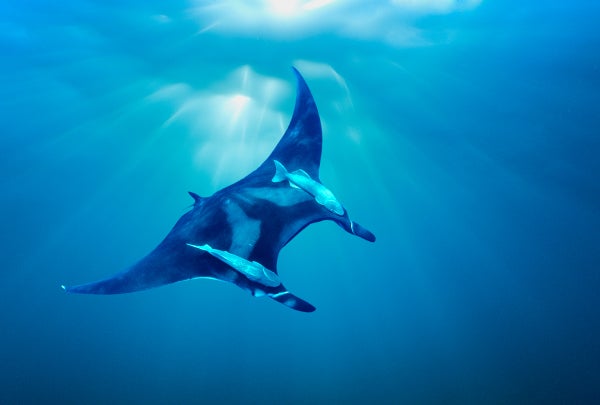

The remora is an unusual fish. It hitchhikes on other sea creatures using a sucker on its head.
“So you can see them on whales, dolphins, sharks, turtles. They stick to scuba divers. They stick to boats, to other fishes, other remoras.”
Brooke Flammang is a comparative biomechanist at the New Jersey Institute of Technology and Rutgers University. She says sticking to other animals is a pretty good strategy.
On supporting science journalism
If you're enjoying this article, consider supporting our award-winning journalism by subscribing. By purchasing a subscription you are helping to ensure the future of impactful stories about the discoveries and ideas shaping our world today.
“They avoid predation by sticking to large animals—no one’s going to attack you if you’re on a shark. It’s a food source—many of them pick parasites off of the host they’re attached to and eat bits of food that are flying by and poop. And they also have the ability to potentially meet other remoras for mating on the same organism.”
But now her team has discovered that the fish have another unusual quality: they’re sensitive to touch—a type of touch previously unknown in the fish world.
“Up until now we didn’t think fish had the ability to sense touch in this way—or to sense dragging and shear, which is going to be very important for a remora, which is attached to something moving very quickly.”
By dissecting the fishes’ suckers and looking at the tissue with electron microscopes and CT scans, they saw an unusual push-button-like structure, which they determined must be a type of mechanoreceptor, enabling a sense of touch.
“We just started poring through the literature, trying to figure out what we were even looking at, and the only thing that has the same structure, a push-rod mechanoreceptor, are monotremes: platypus and echidnas.”
The details are in the journal Royal Society Open Science. [Karly E. Cohen, Brooke E. Flammang, Callie H. Crawford and L. Patricia Hernandez, Knowing when to stick: Touch receptors found in the remora adhesive disc]
The study suggests that this sort of touch perception arose independently at least twice in the animal kingdom: in remoras and monotremes. And big picture?
“I think the real story here is that we just need to look for different sensory capacities in organisms to a much larger extent.”
Because there are a lot of ways that life-forms have come up with to make a living.
—Christopher Intagliata
[The above text is a transcript of this podcast.]
