

Maddie Bender: This is Scientific American 60-Second Science. I’m Maddie Bender.
Take a walk in the woods after dark, and you might hear crickets chirping or frogs ribbiting.
But there’s a sound you will never hear ...
On supporting science journalism
If you're enjoying this article, consider supporting our award-winning journalism by subscribing. By purchasing a subscription you are helping to ensure the future of impactful stories about the discoveries and ideas shaping our world today.
[CLIP: Dendrohyrax dorsalis nigricans call]
... unless you’re traveling across the equator in the center of Africa, from Liberia to Uganda.
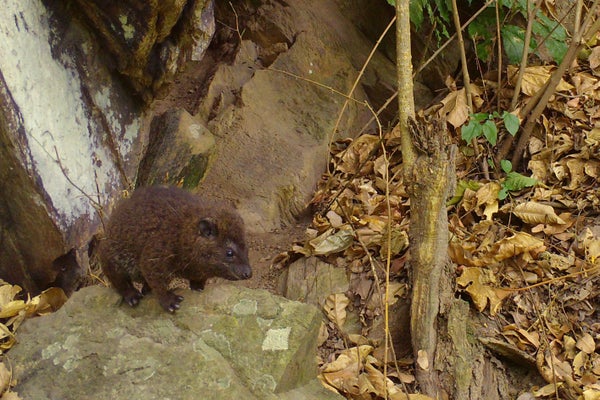
This is the call of a tree hyrax, a small, furry mammal that looks like a cross between a groundhog and a ground squirrel—minus the bushy tail.
John Oates, a professor emeritus of anthropology at Hunter College, says hyrax calls are like none other.
John Oates: The most characteristic sound of the majority of tree hyrax populations is loud, repetitive shrieking or screaming cry that you only hear at night, which reverberates through the forest. And if you’ve never heard it before, at first, it’s quite scary.
Bender: Each species of tree hyrax has its own unique call: due to their distinctive shrieks, Oates and an international team of researchers discovered a new species of the mammal. In 2009 Oates was on an expedition across Nigeria in search of galagos, also known as bush babies.
Here’s a hyrax call like the ones Oates and his colleagues heard in eastern Nigeria. Just be warned: it sounds a lot like a human scream.
[CLIP: D. dorsalis sylvestris call]
But then, when they got to western Nigeria, they heard this at night instead:
[CLIP: D. interfluvialis call]
Oates says they knew instantly that they had a new species on their hands.
Oates: Hearing the two calls in such close proximity in time, one could immediately tell the difference.
Bender: They just had to prove it. Oates and colleagues analyzed the skulls of tree hyraxes from six museum collections. They found that the hyraxes sampled from between the Volta River in eastern Ghana and the Niger River in western Nigeria had differently shaped snouts and inner nostrils from the species of hyraxes to their east and west.
Oates: Scientists have looked at this before but just never happened to notice. They weren’t looking for differences. They seemed to be looking for similarities because everybody accepted that all these hyraxes are the same.
Bender: Next, they sent off samples of hyraxes, mostly collected from bushmeat markets, to have their DNA sequenced. Results from this analysis confirmed their theory: the hyraxes living between those two rivers were genetically distinct.
All that remained was to observe this new species in the wild. Oates says he and his team worked with local villagers to place camera traps strategically.
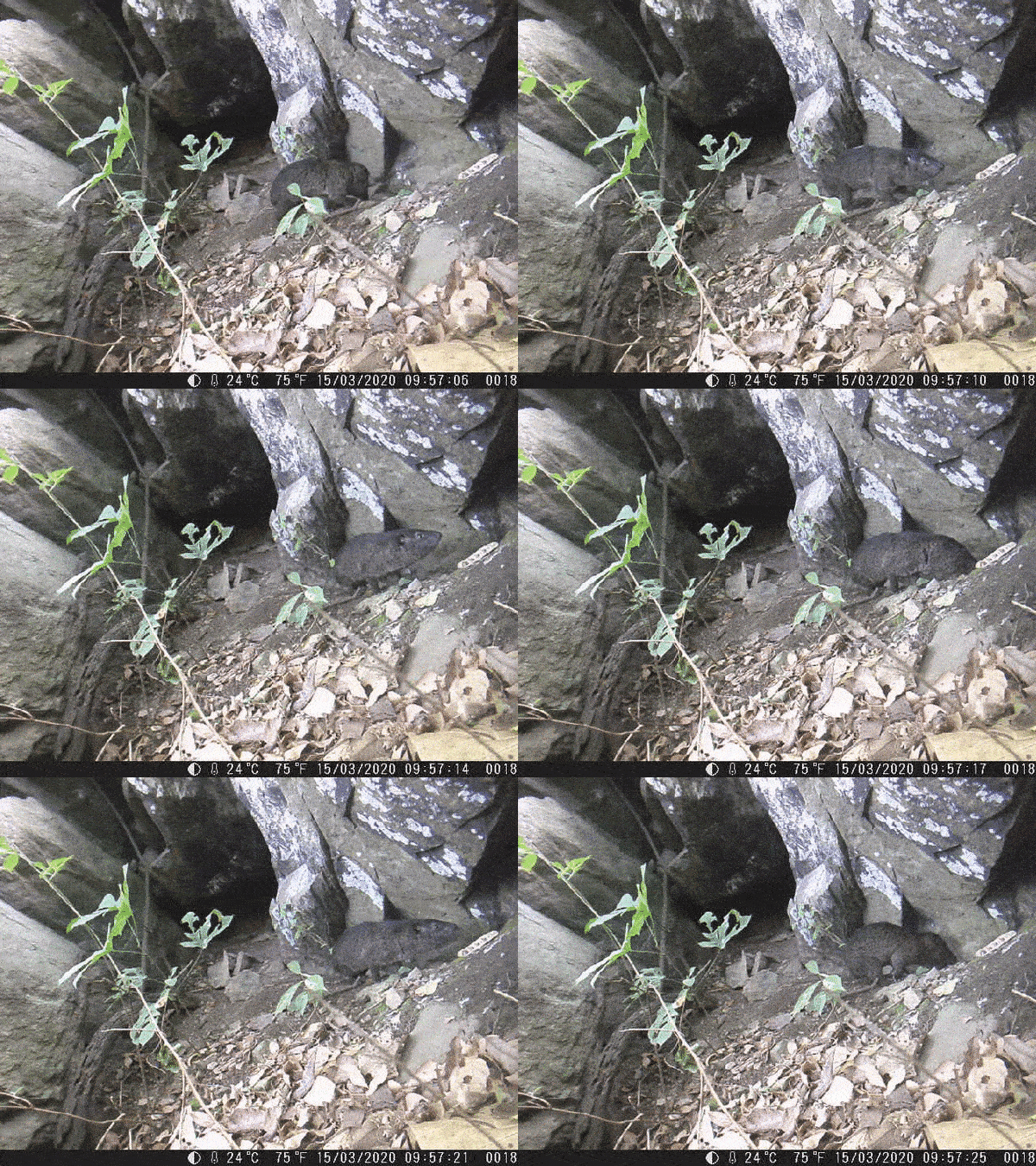
Footage from a camera trap of a new species of hyrax in eastern Uganda. Credit: E. Wiafe and J. Oates
Oates: Following up on something some villagers told us: They said, “Yes, see those rocks up there? They live in those rocks.” Well, tree hyraxes are supposed to sleep in trees. So here’s another intriguing thing.
Bender: They captured footage of the mammals running around and named the new species after the area in which they were found: interfluvialis, or between two rivers. The discovery was published in the Zoological Journal of the Linnean Society. [John F. Oates et al., A new species of tree hyrax (Procaviidae: Dendrohyrax) from West Africa and the significance of the Niger–Volta interfluvium in mammalian biogeography]
There’s an evolutionary reason why the new species lives where it does, Oates says. The rivers on either side of its range provided a geographic barrier where the mammals could have evolved undisturbed.
Oates says his collaborators are working on identifying more species unique to this region, with the hope of making a stronger case for its conservation.
Oates: There’s a lot more to this thing than just this poor little rabbit or marmot or groundhoglike animal that makes strange noises in the middle of the night.
That area has one of the most dense human populations in Africa and one that is still growing and where there’s been a great deal of economic development over the last century, all leading to forest habitats being destroyed at an angle at an alarming rate.
And some of us have been involved there for for some time in trying to hold on to what remnants we can get them declared as national parks, wildlife reserves, community conservation areas so that both the vegetation and these special animals have a chance of surviving.
Bender: Thanks for listening. For Scientific American 60-Second Science, I’m Maddie Bender.
[The above text is a transcript of this podcast.]
Hyrax audio recordings were made available courtesy of Simon Bearder.
