

[CLIP: Series Music]
[CLIP: David Krakauer: So we actually enjoy, cognitively, not knowing, and we pay huge sums of money to not know things.]
[CLIP: Helga Nowotny: The most important thing really is not to be afraid of—not to shrink back but to realize that uncertainty is part of our lives.]
On supporting science journalism
If you're enjoying this article, consider supporting our award-winning journalism by subscribing. By purchasing a subscription you are helping to ensure the future of impactful stories about the discoveries and ideas shaping our world today.
[CLIP: Pascal Wallisch: Well, I think the biggest lesson is: don’t be so sure of yourself. Just because you’re sure does not mean you’re right. This uncertainty is hidden from you.]
[CLIP: C. Brandon Ogbunu: Uncertainty is not a sign of a problem. Uncertainty will be a part of virtually every natural system in the universe. So the idea is: we need to disabuse ourselves of certainty even being a goal.]
Hi Science Talk listeners. I’m Christie Aschwanden, and I’m here to let you know that this podcast feed is about to spring into vibrant life again.
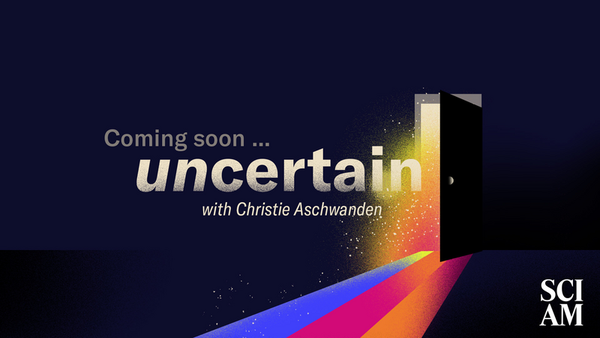
Next week I’m going to be bringing you Uncertain. It’s a weekly, five-part limited podcast series from Scientific American that explores the surprisingly thrilling and deep ways that uncertainty shapes science.
Why uncertainty, you ask? Does the word itself make you nervous? Does it rule your life? Would you say it kinda describes the state of the world these days?
Well, I’ll be helping to demystify uncertainty. I’m gonna take away its scariness–or, rather, a cast of scientific dreamers that I talked to, will.
For this podcast, I talked to a cast of scientific dreamers and superstars who will change the way you think of uncertainty.
As you’ll see, uncertainty drives scientific discovery. Throughout scientific history, uncertainty has spurred our collective imagination and our need to know the things we don’t.
To be clear, uncertainty makes science very difficult. So in this mini-series we’ll both learn how scientists push through those difficulties; and how they also avoid the bias, logical fallacies, and blindspots that can lurk behind uncertainty.
I’ll get them to share their own habits of mind and techniques for facing, and embracing, the unknown.
And even if you’re not a scientist, UNCERTAIN provides a practical way to think through what we don’t know in our lives—to face that uncertainty, and, hopefully, live better, more informed lives because of it.
Make sure to come next week–and for 4 weeks every Wednesday after that, for Uncertain. I promise you it will be a fascinating journey. It might even change your mindset.
Make sure to head over to the Science Talk channel right now every Wednesday for the next five weeks, we’ll bring you a new episode of Uncertain. I promise it will be a fascinating journey. It might even change your mindset.
[CLIP: Series Music]
