
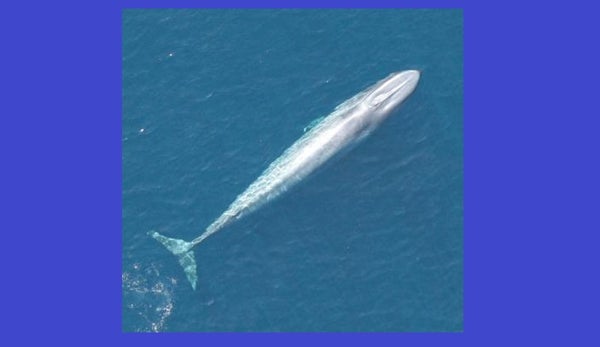

One of the drawbacks of researching blue whales is that most of the time you can't see what your study subjects are doing, or how many there are—or even, where they are. Satellite tags have revealed some of their diving behavior and where they migrate. But tags will never give a complete picture of the population at large.
"Because it's really hard to fit a tag on a whale." Ana Širović, an oceanographer at the Scripps Institution of Oceanography. "We have 121 tags that have been deployed on blue whales. And we're talking about 16 or so years of field work. So it's not realistic to think we can just go out and tag all the animals and figure out that way how many there are."
But Širović is using another method to track the underwater giants—eavesdropping on their songs and calls. <> (That's sped up so you can hear it by the way—much of the sound they produce is outside of our hearing range.)
On supporting science journalism
If you're enjoying this article, consider supporting our award-winning journalism by subscribing. By purchasing a subscription you are helping to ensure the future of impactful stories about the discoveries and ideas shaping our world today.
Širović and her team analyzed more than a decade's worth of blue whale sound. And found that in general, males seemed to be more vocal than females <
"In a way, it's kind of like they don't like to speak with their mouth full. When they're feeding, they're focusing on that, and when they start calling, that's what they're doing."
And though no one's actually seen blue whales having sex, Širović says this song <> may have something to do with it: when the whales are getting more in the mood during the year, that song gets more common. She presented these findings at the recent 2018 Ocean Sciences Meeting in Portland, Oregon. [Ana Širović et al., Insights into blue and fin whale acoustic behavior from fixed passive acoustic recorder and tag data]
Širović's goal is bigger than simply understanding the way whales communicate. "Ultimately the idea is we'd be able to say, 'oh look, there's X number of calls in this area, and we know that means that that is Y number of animals.'" And thus use sound to better understand the lives of these most elusive of study subjects.
—Christopher Intagliata
[The above text is a transcript of this podcast.]
