
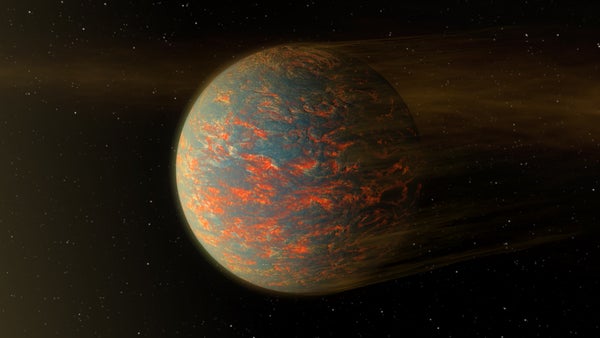

Here on Earth, your best bet for seeing lava is to go to a volcano. But out in space, there are entire exoplanets made of the stuff. These so-called lava worlds orbit so close to their stars that their surface temperatures can melt rock—which might sound familiar, says space technologist Mihkel Pajusalu of the University of Tartu in Estonia.
“For example, from science fiction, we know, from Stars Wars: Episode III, Mustafar planet ...”
[CLIP: Star Wars scene]
On supporting science journalism
If you're enjoying this article, consider supporting our award-winning journalism by subscribing. By purchasing a subscription you are helping to ensure the future of impactful stories about the discoveries and ideas shaping our world today.
Kinda like that but, you know, without the light sabers. Scientists had noticed that some of these real lava worlds were extraordinarily bright and reflective. But why?
“There was the idea that maybe it comes from the fact lava itself is basically a liquid, and a smooth surface can reflect light. Like the surface of water, for example.”
So Pajusalu and his colleagues did what anyone would do to test that idea: they made their own lava. Here’s M.I.T.’s Zahra Essack, who led the team.
“When we removed the lava from the furnace, you could instantly feel the heat wash over you. Even from six feet away, it felt like you were standing right on the edge of a roaring bonfire. The crucible, which was the container holding the lava, was glowing so brightly, it made my eyes water. It was an incredible experience.”
After producing the lava, the researchers calculated its reflectivity in both the molten and solid states. And they realized that lava wasn’t reflective enough to explain these bright exoplanets they were seeing. Instead, Essack says, perhaps these planets could be remarkable in yet another way.
“We think that lava planets could have exotic reflective atmospheres consisting of silica, which is the main component of rocks, and metals like sodium and potassium that could reflect starlight and make the planets appear very bright.”
The work appears in the Astrophysical Journal. [Zahra Essack et al., Low-albedo surfaces of lava worlds]
If lava worlds feel very far away, and perhaps irrelevant, Essack brought up the fact that Earth was once covered in sloshing lava early in its formation. So by studying planets around distant stars, we might better understand the history of our own.
—Christopher Intagliata
[The above text is a transcript of this podcast.]
