
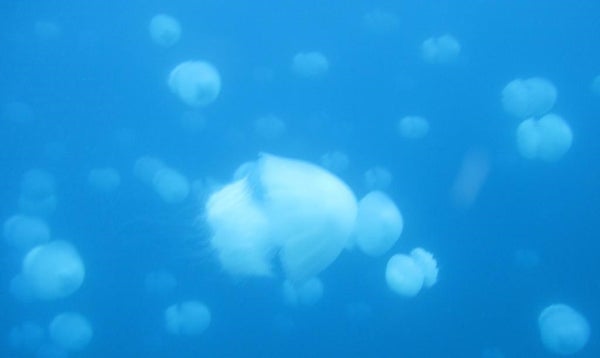

The Mediterranean Sea is home to some 17,000 native species. But it's also home to a growing number of non-native species: 756 at last count. 756 may not sound like a lot, compared to 17,000.
"But this is not arithmetic." Bella Galil, a naturalist at Israel National Center for Biodiversity Studies in Tel Aviv. "Those invasive species have a large population, and they rend apart the native food web. They disturb an already stressed community."
The invaders she's talking about are central casting for an underwater horror movie. Take the nomadic jellyfish, in huge swarms 60 miles long, which sent hundreds of people to Turkish hospitals a few summers back. Or a type of pufferfish, extremely poisonous, that occasionally gets fished out, and lands at fish markets by mistake.
On supporting science journalism
If you're enjoying this article, consider supporting our award-winning journalism by subscribing. By purchasing a subscription you are helping to ensure the future of impactful stories about the discoveries and ideas shaping our world today.
Galil says these bad guys, and many others, have invaded the Mediterranean through the ever-widening Suez Canal. As the canal grows, so do the number of non-native species. And it's a dilemma that's not easily addressed. "It's a Humpty-Dumpty sort of problem. Once it's broke it's broke. We cannot re-engineer it. It's too complex for us." Galil and her team outline the scope of the problem in the journal Management of Biological Invasions. [Bella Galil et al., The enlargement of the Suez Canal—Erythraean introductions and management challenges]
Installing locks or salinity barriers could help block future invasions, she says—those methods have worked in other canals. But that's an engineering and governance issue. "As biologists we've raised our voices. The community is aware of it. The problem is to go beyond this. And to go beyond this we need to go into the regional bureaucracy and the industry." It'll undoubtedly cost money, too. One motivating factor for taking action: Mediterranean beaches are big business. And swarms of jellyfish can quickly drive away the customers.
—Christopher Intagliata
[The above text is a transcript of this podcast.]
