
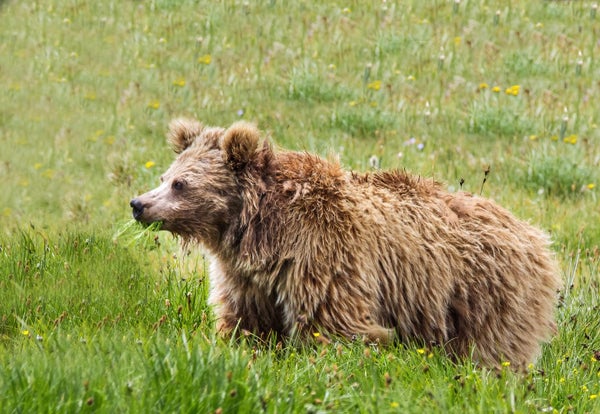

The Yeti. Also known as the abominable snowman. It’s a legendary primate some people believe exists in the Himalayas and adjacent freezing lands. But what do you get when you use modern DNA techniques to analyze bodily samples allegedly left by yetis? Well, eight times out of nine, you wind up with the genetic signature of your non-abominable neighborhood bear.
These unmysterious results are revealed in the Proceedings of the Royal Society B. [Tianying Lan et al., Evolutionary history of enigmatic bears in the Tibetan Plateau–Himalaya region and the identity of the yeti]
This new study is not the first to examine DNA extracted from samples allegedly derived from yetis. Analysis of short DNA fragments from a pair of samples collected in India and Bhutan matched that of an ancient polar bear bone. That 2014 finding raised the possibility that the abominable snowman could actually be a previously unrecognized bear species—or even some sort of hybrid brown bear-polar bear that wanders the Tibetan plateau.
On supporting science journalism
If you're enjoying this article, consider supporting our award-winning journalism by subscribing. By purchasing a subscription you are helping to ensure the future of impactful stories about the discoveries and ideas shaping our world today.
In the current study, researchers conducted a more comprehensive comparison of DNA from 24 samples, including nine that supposedly came from yetis. These specimens, collected from the field or borrowed from museums, included bits of hair, bone, skin and scat.
Eight of the nine yeti samples were identified as actually coming from the Asian black bears, Himalayan brown bears and Tibetan brown bears that call this remote region home. But what about that ninth sample? Yeah, it was from a dog. The abominable Fido, maybe.
On the serious side, the analysis did address a mystery of a more scientific nature regarding the evolution of these local bear populations. The results suggest that Himalayan brown bears belong to a distinct evolutionary lineage that diverged from the other bears during the greatest of earth’s ice ages.
Cut off by the spread of glaciers, these bears have been keeping to themselves for more than 650,000 years. That period of isolation has rendered them rare and elusive—but still very real. Which we cannot say about the abominable snowman. At least not yeti.
—Karen Hopkin
[The above text is a transcript of this podcast.]
