
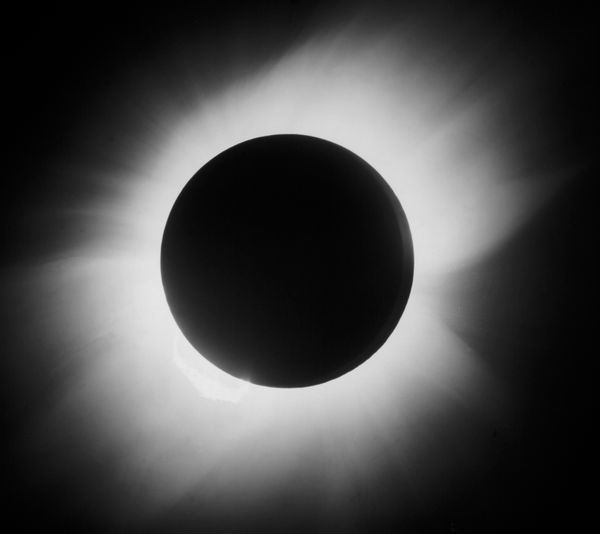
On Wednesday a total solar eclipse will pass over Iceland and other parts of Europe. And while many scientists will be trying to answer new questions, one will aim to re-create one of history’s most famous eclipse studies: the Eddington experiment.
Conducted on May 29, 1919, the Eddington experiment made the pages of Scientific American that same year. The goal was to verify Albert Einstein’s general theory of relativity, which posited that gravity was not a pulling force but actually the warping of spacetime.
British astronomer Arthur Eddington knew that, under Einstein’s hypothesis, the sun should bend the light of other stars. But this would not be visible during normal daylight conditions because the glare of the sun would drown out that light. A total solar eclipse offered a unique moment to test the theory.
On supporting science journalism
If you're enjoying this article, consider supporting our award-winning journalism by subscribing. By purchasing a subscription you are helping to ensure the future of impactful stories about the discoveries and ideas shaping our world today.
Eddington set up telescopic cameras in two locations—the island of Príncipe off the coast of Africa and the Brazilian city Sobral—and compared the resulting photographs to existing star maps. Sure enough, during the eclipse the stars appeared where Einstein’s calculations predicted they would.
Here’s how Scientific American covered the experiment in November 1919 in an article by astronomer Henry Norris Russell:
This report affords one of the rare instances in which a topic of pure science assumes sufficient journalistic importance to justify cable despatches [sic] a column long; and in this case at least the real importance of the discovery is commensurate with the popular attention which is devoted to it.
Crudely put, it is evident that the sun, and presumably any other large body, attracts passing waves of light and deviates their paths. The deviation is small, only 13⁄4 seconds of arc for a ray which has passed close to the sun; but it is twice as great as the deflection which would be produced according to the familiar theory by the sun’s attraction on the motion of a material particle moving past it with the velocity of light.
One of the landmark scientific experiments of the 20th century, Eddington’s achievement made the news alongside other notable developments in science and engineering at the time: a mechanical hand that held a phone receiver for the user, for instance, and the then shocking decision by the U.K. to temporarily abandon work on airships some 18 years before the Hindenburg disaster.
Now University of Iceland Ph.D. student Matthias Harksen will be re-creating the Eddington experiment. The famed experiment can be replicated by anyone with a telescope, and Harksen hopes his example will inspire others to try it out and learn more about Einstein’s work. (Be sure to attach a solar filter to your telescope beforehand. Looking at an eclipse through an unfiltered telescope will cause permanent eye damage even if you are wearing eclipse glasses.)
To learn more about the solar eclipse and see the path of totality, check out our eclipse guide.