
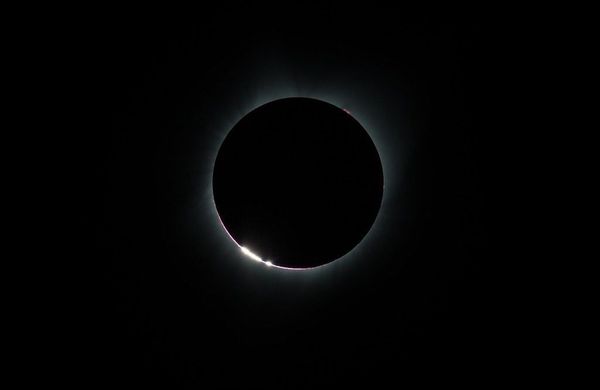
Ready to look up and gaze (safely) at the sun? A total solar eclipse is less than one week away, and Scientific American is going to be on the ground in Spain and Iceland to bring you live updates and incredible images of this celestial phenomenon in all its glory.
The total solar eclipse will take place on August 12, when millions of sky-gazers will, for a few brief minutes, see the world plunged into darkness as the moon passes directly in front of our star.
For millennia, humans have been fascinated by eclipses. Neolithic monuments such as Stonehenge likely owe their existence to that intrigue. There’s even a branch of science—archaeoastronomy—dedicated to investigating how ancient cultures tracked and perceived celestial phenomena, including eclipses. The Maya, for example, observed and calculated intervals between solar and lunar eclipses, building predictions and calendars around the pattern. Ancient Chinese scholars made records of solar eclipses, and diviners made prophecies during these auspicious events.
On supporting science journalism
If you're enjoying this article, consider supporting our award-winning journalism by subscribing. By purchasing a subscription you are helping to ensure the future of impactful stories about the discoveries and ideas shaping our world today.
Today astronomers have a greater understanding of eclipses, but our fascination is as strong as ever. Here’s everything you need to know about the coming solar eclipse, from the path of totality to the weather forecast to ways that you can photograph the event.
When is the 2026 solar eclipse?
The 2026 solar eclipse begins and ends on August 12. For viewers in northern Russia, Alaska and northern Canada, the eclipse will take place in the morning local time. Canada’s eastern provinces will see the moon pass in front of the sun in the afternoon, while viewers in Europe will see the eclipse in the evening, around sunset. (Reminder: never look directly at the sun without adequate eye protection.)
As noted, Scientific American will have journalists on the ground to watch the eclipse from Iceland and Spain.
In Reykjavík, Iceland’s capital, a partial eclipse—when the moon will start to pass in front of the sun, creating a crescent effect—will begin at 4:47 P.M. local time. Totality—the moment the moon will fully shroud the sun—will start at 5:48 P.M. and end at 5:49 P.M. The entire event will last until 6:47 P.M., when the moon will move past our solar disk.
And in Valencia, Spain, the eclipse will begin at 7:38 P.M. local time. Totality will start at 8:32 P.M. and end at 8:33 P.M. The entire event will conclude after sunset, at 9:01 P.M., meaning viewers can expect to see the moon passing in front of the sun even as the horizon appears to swallow up its light.
As you might have already gathered, the moment of totality really be a moment—just more than a minute. That’s far shorter than it was in the last total solar eclipse, which occurred in 2024. In that eclipse, totality lasted around four minutes.
NASA will begin livestreaming the eclipse at 1:15 P.M. EDT on August 12.
What is the path of totality?
The best views of this solar eclipse are from the Arctic Circle, Iceland, Spain and parts of Portugal.

Annika Hoerner
People who aren’t in the path of totality may see a partial eclipse. For example, skygazers in Berlin will see 85 percent of the sun shrouded by the moon at 8:08 P.M. local time. Dubliners and Londoners will be treated to 94 percent and 91 percent coverage, respectively, at around 7:10 P.M. local time.
Unfortunately, much of the population of North America will not see a lot. A total of 9 percent of the sun will be covered when viewed from New York City at 1:54 P.M. EDT, while Portland, Maine, will see 19 percent of the sun covered at around the same time.
What will the weather be like?
When it comes to solar eclipses, timing matters but so does cloud coverage. Our map reveals expected coverage along the path of totality.

Annika Hoerner; Source: Climate Data Store (cloud cover data)
How to see the eclipse
Never look directly at the sun with unprotected eyes. To see even a partial eclipse, you must use safe eclipse glasses or another safe handheld solar viewer. Importantly, sunglasses are not good enough to protect against eye damage from looking at the sun directly. Safe eclipse glasses are those that comply with the ISO 12312-2 standard.
Don’t point telescopes, binoculars or cameras at the sun either, even if you are wearing eclipse glasses. The lens of these devices concentrates the solar rays and can damage your vision. You can get special solar filters to make them safe for viewing, through. Check out our guide on how to photograph an eclipse.
Indirect ways to see an eclipse include a pinhole camera or even leaves on trees—they project the shadow of the eclipse onto the ground beneath them.
Check the weather before you set up; cloud coverage and other conditions can change fast.