
We still have so much to learn about life on our planet and its boundless capacity to adapt to different situations and environments. And every year researchers discover wild and astounding—and often amusing—ways that animals avoid predators, explore their surroundings or, you know, escape from a wriggling ball of their compatriots.
Below, Scientific American has rounded up a few of our favorite animal antics from the past year. We hope they’ll inform and amaze you—and maybe even make you laugh.
This Fish Does an Electric Boogie to “See” Its Surroundings
On supporting science journalism
If you're enjoying this article, consider supporting our award-winning journalism by subscribing. By purchasing a subscription you are helping to ensure the future of impactful stories about the discoveries and ideas shaping our world today.
This funky-looking fish—which resembles Gonzo the Muppet—has a wild way of seeing the world around it. The aptly named elephantnose fish dwells in murky river waters that render eyesight unhelpful for navigating. So instead an organ in its tail emits a weak electric field, and receptors on its skin (including that elephantlike protrusion called a schnauzenorgan—yes, really) then register when that field bounces off nearby objects. The fish shimmies and wiggles to move the electric field around to generate a three-dimensional “image” of its surroundings. You could say this fish does the electro-locomotion. Ba-dum-ching!
How Penguin Parents Get Their 40 Winks
Human parents, prepare to be jealous. Nesting chinstrap penguins must stay vigilant 24/7 while they incubate their eggs to protect them from getting eaten by predators or being jostled in the crowded colonies where they dwell. So how do they get enough rest to avoid being exhausted? Researchers used cameras, sensors that register brain activity and other equipment to monitor the birds and found that they take more than 10,000 “micronaps” averaging around four seconds long every day. That adds up to more than 11 hours of sleep per day!
Escape from the Worm Ball
.gif)
A worm ball explodes. Credit: Harry Tuazon
How does a California blackworm get out of a tight knot? No, it’s not the setup to a joke. Rather, it takes a simple application of muscles and neurons—which scientists have represented with mathematical models—for the worms to escape from what looks like a ball of wriggling spaghetti in a matter of milliseconds. The aquatic worms congregate in writhing spheres, but they can separate in a flash to escape predators. The models show that the worms extricate themselves by repeatedly moving their heads clockwise and then counterclockwise, creating a figure-eight pattern called an alternating helical wave. (To tangle themselves up, they corkscrew themselves in one direction.) Studying these worms could help scientists untangle other knotty problems.
Arachnophobes Beware
It’s a good thing Dawn Sturgess isn’t an arachnophobe. When she looked out her window in England the summer before last, she spotted a shrew caught in a spider’s web; the shrew was struggling as the arachnid’s venom slowly shut down its nervous system. The female noble false widow spider then hoisted its victim—many times larger than itself—up into the rafters, where the arachnid broke down and consume its meal. This report adds to mounting evidence that spiders prey on small vertebrates more often than we knew—and not just relatively mammoth spiders but smaller ones, too. Sweet dreams!
Meet the Insects That Catapult Away Their Pee
“You never stop to think about how insects pee,” Georgia Institute of Technology Ph.D. student Elio Challita says. And that feels like a pretty safe assumption for most people. But Challita and Georgia Tech biomolecular engineer Saad Bhamla did stop to think about this after observing sharpshooter insects relieving themselves in the researchers’ own backyards. They discovered that the insects—which fling droplets of pee away with a catapultlike structure called an anal stylus—are the first organisms known to use a physics phenomenon called superpropulsion to do so without expending too much energy. Because the liquid droplets are so pliable, they can compress and store energy in surface tension before being flung by the stylus. When released, the droplets move at speeds about 40 percent faster than the stylus. Imagine if a pitcher could do that with a baseball!
Attack of the Killer Whales
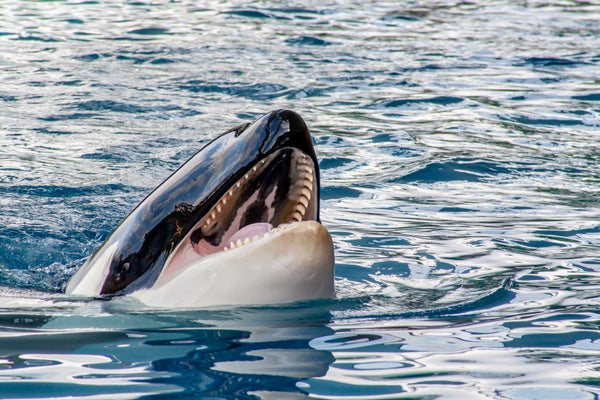
If you happen to be sailing in the waters off Spain and Portugal, watch out for orcas. There, groups of these marine mammals, also called killer whales, have been attacking—and even in a few cases, sinking—vessels from fishing boats to yachts. They often go for the rudder and sometimes scrape the hull with their teeth. Why the Iberian orcas are messing with boats isn’t clear—some experts posit it could be because of negative interactions with boats in the past. Others suggest it could be a fad. Subpopulations of killer whales are known to engage in fads of varying nature, just like humans adopting pet rocks or doing the “Macarena.”
These Young Frogs Look Like Crap
Adult Wallace’s flying frogs, which spring from branch to branch in tropical forests, are an appropriately jungle-green hue. But young froglets (their life stage after metamorphosizing from tadpoles but before fully maturing) are a standout reddish orange with white flecks. Why would an animal in such a vulnerable life stage take on such an outrageous appearance? Scientists think they’re masquerading as poop to gross out would-be predators. And according to the more than 150 birds in the Vienna Zoo’s Southeast Asian rainforest house that were exposed to wax froglet models of different colors, it works.